

 -by
-by Travel headlines can be misleading when they use dramatic phrases such as “Europe freezes US travel.” For most travelers, this does not automatically mean that Europe has banned Americans from visiting. Instead, the phrase can refer to changing travel rules, diplomatic tensions, safety concerns, airline disruptions, new border systems, or individual European countries issuing updated guidance that affects how Americans plan a trip.
The important question is therefore not simply, “Can Americans still travel to Europe?” It is: Which country, rule, or travel condition is changing, and how does it affect my specific trip? Europe is not a single immigration authority. Entry rules can involve the Schengen Area, the European Union, individual countries, airlines, and border officials.
This guide explains what travelers should understand when reports suggest that Europe is restricting or “freezing” US travel. You will learn how to separate headlines from official policy, check entry requirements, prepare for new border procedures, respond to cancellations or disruptions, and protect your travel plans. The goal is to help beginners, frequent travelers, and global readers make informed decisions rather than react to an alarming headline alone.
What Does “Europe Freezes US Travel” Actually Mean?
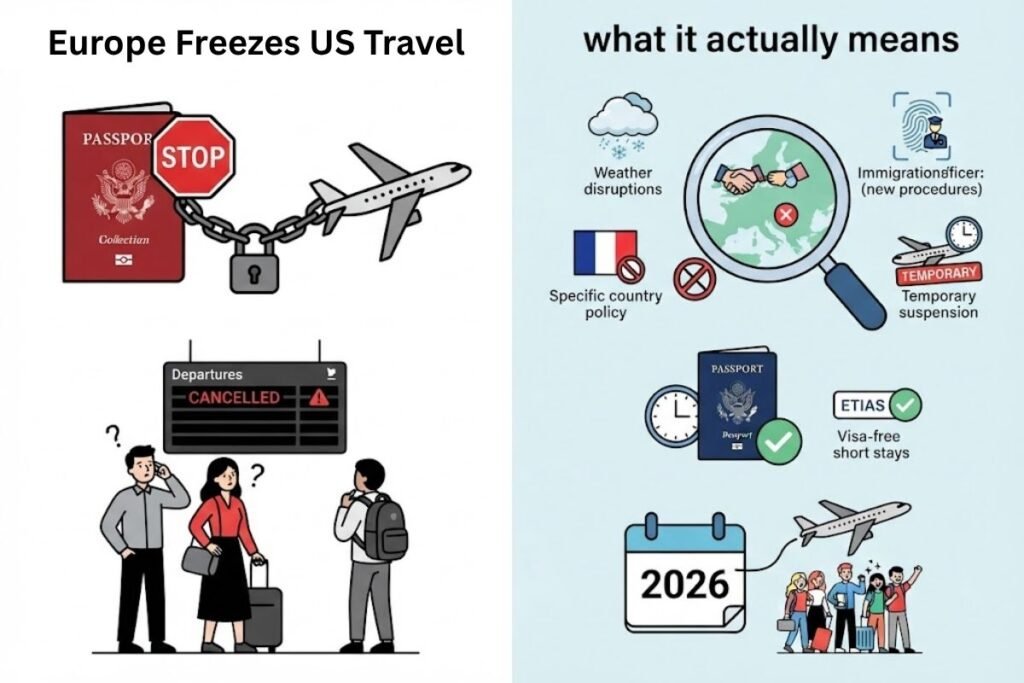
The phrase Europe freezes US travel is ambiguous and should not be treated as proof that all American travel to Europe has stopped. As of August 2026, official EU information shows that U.S. citizens can still travel visa-free for eligible short stays to the relevant European countries, subject to the applicable entry rules.
However, Europe’s border procedures have changed with the Entry/Exit System (EES), and ETIAS is scheduled to begin in the last quarter of 2026, with the exact launch date still to be officially announced. In other words, a headline about a “freeze” may describe something much narrower than a continent-wide travel ban.
It could refer to:
- A temporary suspension of flights.
- Severe weather disrupting airports, roads, or rail networks.
- A diplomatic or political dispute.
- A government travel warning.
- New immigration or border procedures.
- A specific country’s policy rather than all of Europe.
- A change affecting European travel to the United States rather than American travel to Europe.
- A booking slowdown or tourism campaign that is described dramatically in news coverage.
This distinction matters because travel decisions based on an oversimplified headline can lead to unnecessary cancellations, lost money, or confusion.
The Most Important Fact: Europe Is Not One Border System
One of the biggest mistakes travelers make is treating Europe as a single country. Europe includes many sovereign countries. The European Union, the Schengen Area, and the wider geographical region of Europe do not have identical membership or identical travel rules.
For example:
- Some European countries are part of the Schengen Area.
- Some EU countries have different border arrangements.
- The United Kingdom has its own immigration system.
- Ireland has separate immigration arrangements from the Schengen Area.
- Countries outside the EU may establish their own entry requirements.
- Local governments can issue their own safety or transportation guidance.
Therefore, when you see a report claiming that “Europe freezes US travel,” ask a more precise question: Which authority made the decision, which travelers are affected, and what type of travel is involved? That question often reveals whether the headline affects your trip at all.
Is Europe Closed to American Travelers?
No general Europe-wide closure to American leisure travelers should be assumed from the phrase alone. American travelers should instead check the current rules for their destination, transit points, passport status, and travel dates.
For eligible short visits, U.S. citizens generally travel visa-free to participating European destinations, subject to the applicable 90-days-in-any-180-days rule and other entry conditions. The EU’s new systems add procedures but do not automatically mean that visa-free travel has ended.
However, entry permission is never the same as a guaranteed right to board a flight or enter a country. Airlines can refuse boarding when required documents are missing, and border authorities make entry decisions under the applicable laws. That is why travelers should verify their own circumstances rather than relying on a general statement found on social media.
Why Travel Headlines Can Be Confusing
Travel news often compresses complicated events into a short, dramatic phrase. The problem is that the same phrase can describe several completely different situations. Consider these examples.
Example 1: A weather disruption
Suppose snow and ice close runways at a major airport. Flights may be canceled, passengers may miss connections, and rail services may experience delays. In January 2026, severe winter weather caused extensive flight and transportation disruption in parts of Europe, including major disruption at Amsterdam’s Schiphol Airport. That is a serious travel disruption, but it is not the same as Europe banning American visitors.
Example 2: A new border system
Suppose travelers are required to provide biometric information or obtain a digital travel authorization. This may feel like a new restriction, but it does not necessarily eliminate visa-free travel. It may simply change the process travelers follow.
Example 3: A diplomatic disagreement
Political tensions can lead governments to issue warnings, reconsider policies, or change official travel advice. A warning may encourage travelers to reconsider a destination without legally prohibiting travel.
Example 4: A country-specific policy
A rule affecting France, Spain, or another individual destination does not automatically apply to every European country. The practical lesson is simple:
Never make a travel decision based only on a headline containing the word “Europe.”
Understanding the New European Border Systems
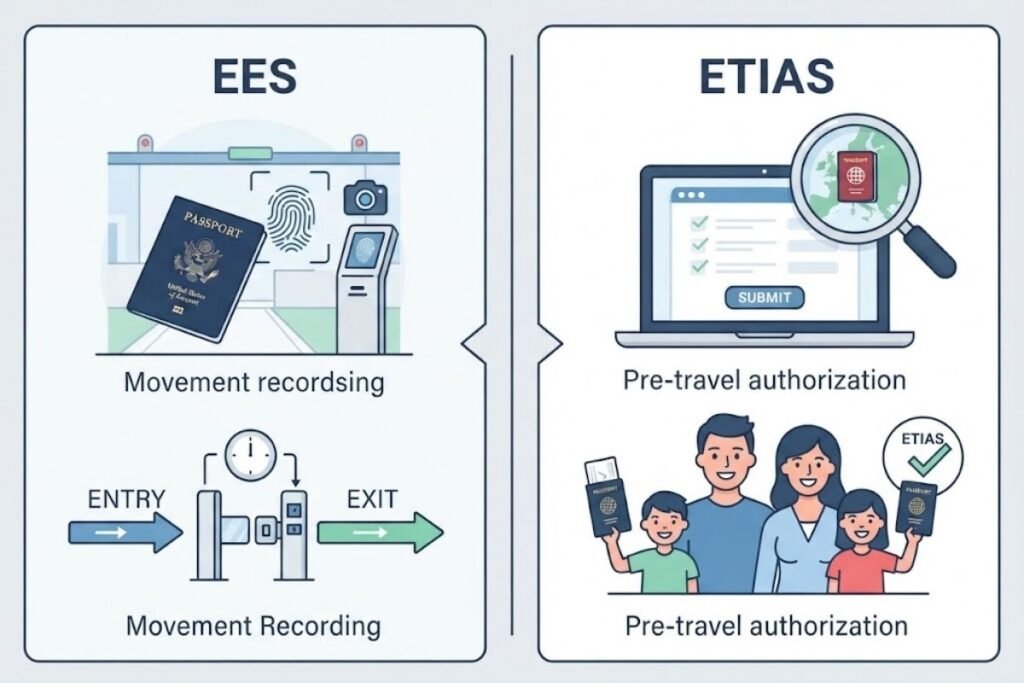
For American travelers, one of the most important current developments is the modernization of European border procedures.
Two systems can be confusing:
- EES — Entry/Exit System
- ETIAS — European Travel Information and Authorisation System
They are different systems and serve different purposes.
What Is the Entry/Exit System (EES)?
The Entry/Exit System, or EES, is a digital border management system used for short-stay travel by eligible non-EU nationals entering the participating Schengen countries.
The system records travel information electronically and includes biometric information at the border, including a facial image and fingerprints for applicable travelers. The EU states that EES became fully operational at Schengen external border crossing points on April 10, 2026.
What American travelers should expect
Depending on the circumstances and border location, the process can include:
- Passport or travel document verification.
- Collection or verification of biometric data.
- Digital recording of entry and exit.
- Questions from border officials where appropriate.
EES replaces the traditional reliance on manual passport stamping with electronic records for covered travelers.
Why it matters
A traveler who has visited Europe many times may notice that the border process feels different.
That does not mean the traveler needs to panic. It means they should:
- Allow extra time at the border.
- Follow airport or border instructions.
- Make sure their passport meets applicable validity requirements.
- Keep proof of accommodation and onward or return travel available if requested.
What Is ETIAS?
ETIAS is a travel authorization system, not a visa. Once it becomes operational, visa-exempt travelers from countries including the United States will generally need an approved ETIAS travel authorization before traveling to the covered European destinations for eligible short stays.
As of August 2026, the EU states that ETIAS is scheduled to begin in the last quarter of 2026, but travelers should wait for the official launch information rather than using unofficial websites or paying third parties prematurely.
EES vs. ETIAS: The Simple Difference
| Feature | EES | ETIAS |
| Main purpose | Records entry and exit information | Pre-travel authorization |
| When it happens | At the border | Before travel |
| Applies to | Covered non-EU short-stay travelers | Covered visa-exempt travelers |
| Biometric information | Yes, where applicable | Authorization is linked to the travel document |
| Is it a visa? | No | No |
| Key action for travelers | Complete border procedures | Apply before departure once operational |
The EU specifically distinguishes these two systems and explains that an American traveler may encounter both: ETIAS authorization before the journey once it is operational, followed by EES registration at the external border.
How the 90/180-Day Rule Works
One of the most commonly misunderstood European travel rules is the 90 days in any 180 days rule for short stays in the Schengen Area. This does not mean that every traveler can spend 90 days in Europe, leave for one day, and immediately return for another 90 days. Instead, the calculation looks backward over a rolling 180-day period.
Simple example
Imagine that you spend:
- 30 days in France.
- 30 days in Italy.
- 20 days in Spain.
You have used 80 days of your permitted short stay within the relevant 180-day period. You may have only 10 days remaining before reaching 90 days, depending on your exact travel dates and circumstances.
This is particularly important for:
- Digital nomads.
- Long-term tourists.
- Frequent business travelers.
- Travelers visiting multiple European countries.
- People who make repeated short trips.
Do not assume that crossing from one Schengen country to another resets the clock. If your trip is complicated, use an official calculator or seek guidance from the appropriate immigration authority.
What to Do Before Canceling a Trip to Europe
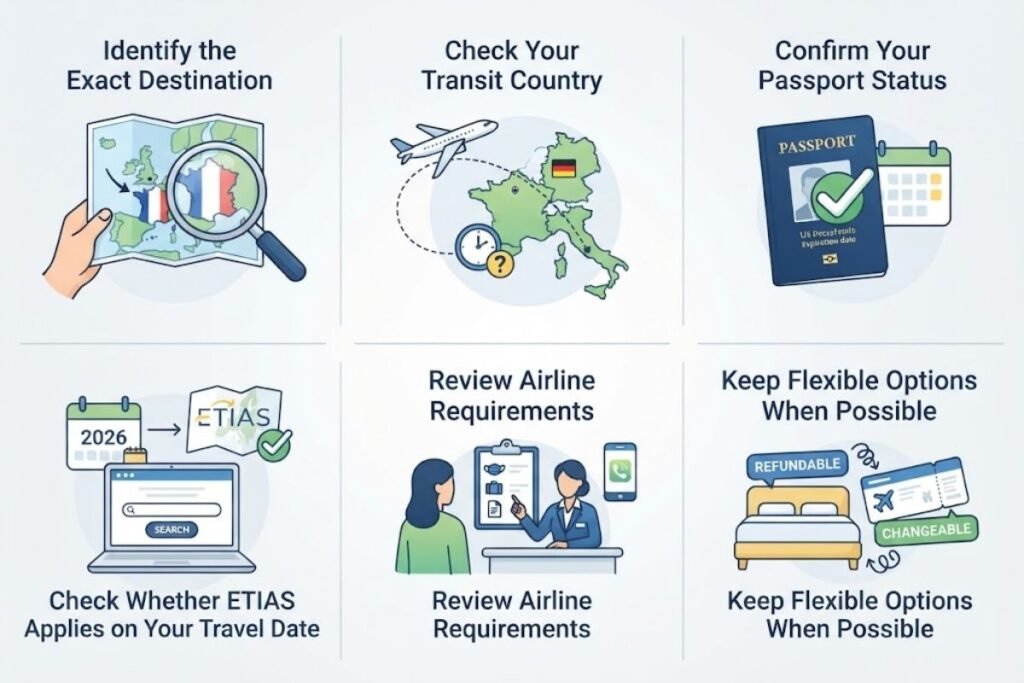
If you see alarming news about American travel to Europe, do not immediately cancel your vacation. Follow this process instead.
Step 1: Identify the Exact Destination
Do not search only for:
“Can Americans travel to Europe?”
Search for the specific country.
For example:
- “US citizen entry requirements France”
- “US citizen travel rules Spain”
- “Italy border requirements American travelers”
- “Germany travel advisory US citizens”
Then verify the information through an official government or European Union source.
Step 2: Check Your Transit Country
Your destination may not be the only country that matters.
For example, you may travel:
United States → Amsterdam → Greece
Even if Greece is your final destination, a major disruption at Amsterdam could affect your trip.
Check:
- Flight connections.
- Transit rules.
- Airport operating conditions.
- Airline notifications.
- Potential alternative routes.
Step 3: Confirm Your Passport Status
Before purchasing a nonrefundable trip,
check:
- Passport expiration date.
- Passport condition.
- Applicable passport validity requirements.
- Whether your passport will remain valid for the required period after your planned departure.
The official ETIAS guidance also states that, once the system is operational, travelers will need an eligible travel document and outlines document validity requirements for the authorization process.
Step 4: Check Whether ETIAS Applies on Your Travel Date
This point is especially important for trips planned for late 2026 or later. Do not assume that ETIAS applies simply because you read an older article. At the time of writing, the EU states that ETIAS is scheduled for the last quarter of 2026 and that no traveler action is currently required until the system officially begins. Check the official ETIAS website before departure.
Step 5: Review Airline Requirements
Your airline may verify required travel documentation before boarding.
Check your booking directly through:
- The airline’s official website.
- The airline’s official mobile application.
- Customer support channels listed on the official website.
Be cautious about unsolicited messages claiming that you need to pay an urgent “Europe travel clearance” fee.
Step 6: Keep Flexible Options When Possible
For uncertain travel periods, consider:
- Changeable flights.
- Accommodation with reasonable cancellation terms.
- Travel insurance appropriate to your needs.
- A backup route through another airport.
Flexibility can be more valuable than choosing the lowest possible fare. For a smoother international trip, smart packing and flexible planning can also make unexpected travel changes easier to manage. Check our complete guide to Backpack and Travel for practical packing and preparation tips.
A Practical Travel Checklist for Americans Visiting Europe
Before departure, review the following.
Travel documents
- Valid passport.
- Required visa, if your circumstances require one.
- ETIAS authorization if it is officially required for your travel date.
- Copies of important documents stored securely.
- Proof of onward or return travel where appropriate.
Trip planning
- Confirm flight status.
- Check your transit airport.
- Review local transportation conditions.
- Confirm accommodation.
- Understand the 90/180-day rule if traveling within the Schengen Area.
Financial preparation
- Inform your bank if necessary.
- Carry more than one payment method.
- Keep emergency funds accessible.
- Understand currency conversion and foreign transaction fees.
Emergency preparation
- Save embassy or consular contact information.
- Save airline customer-service information.
- Share your itinerary with a trusted person if appropriate.
- Keep essential medications and valuables in your carry-on luggage.
Common Mistakes Travelers Make
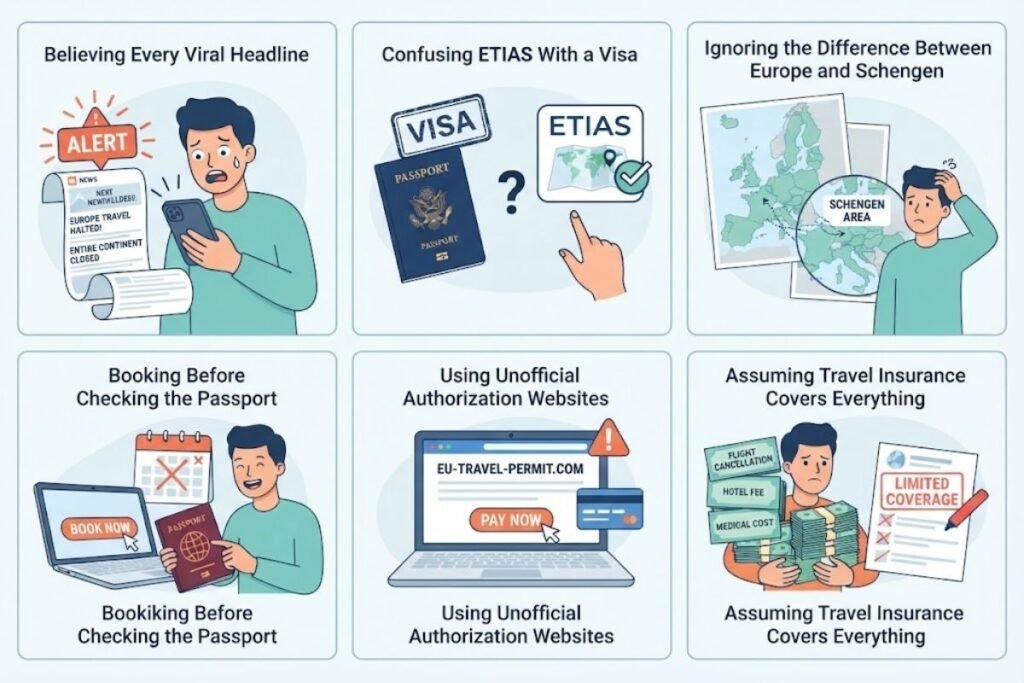
Mistake 1: Believing Every Viral Headline
A social media post may use words such as:
- Ban.
- Freeze.
- Shutdown.
- Lockdown.
- Block.
- Travel crisis.
The underlying event may be much narrower. Before acting, find the original government announcement, airline notice, airport advisory, or official policy document.
Mistake 2: Confusing ETIAS With a Visa
ETIAS is a travel authorization, not a visa. However, that does not mean every traveler has identical requirements. Visa requirements can depend on nationality, length of stay, purpose of travel, residence status, and other factors.
Mistake 3: Ignoring the Difference Between Europe and Schengen
Travel rules for the Schengen Area should not automatically be applied to every European country. A multi-country itinerary may involve different systems.
Mistake 4: Booking Before Checking the Passport
A discounted fare can become expensive if your passport does not meet the applicable requirements. Check first.
Mistake 5: Using Unofficial Authorization Websites
When ETIAS officially launches, use the official EU channels. Travel authorization systems can attract websites that charge additional service fees or create confusion. The European Commission specifically directs travelers toward official ETIAS channels.
Mistake 6: Assuming Travel Insurance Covers Everything
Insurance policies vary.
Before buying, check:
- Cancellation coverage.
- Trip interruption coverage.
- Medical coverage.
- Weather-related disruption rules.
- Airline delay coverage.
- Exclusions.
The cheapest policy may not protect against the disruption that concerns you most.
What Happens if Flights Are Suddenly Frozen or Canceled?
A “travel freeze” can sometimes be a practical transportation problem rather than an immigration restriction. Severe weather can shut runways, delay trains, close roads, and disrupt airport operations. Major winter weather in Europe during January 2026 demonstrated how quickly a regional weather event could create widespread flight and rail disruption. If your flight is canceled, take these steps.
01. Check the Airline App First
Airlines often update rebooking options digitally before airport service desks can process every passenger.
Look for:
- Automatic rebooking.
- Alternative flights.
- Refund options where applicable.
- Travel waivers.
02. Avoid Unverified Customer-Service Numbers
During disruptions, scammers may impersonate airlines. Use contact details from the airline’s official website or application. KLM specifically warned travelers about phishing attempts during the January 2026 disruption.
03. Save Evidence
Keep:
- Boarding passes.
- Cancellation notices.
- Receipts.
- Hotel invoices.
- Transportation receipts.
- Written communication from the airline.
These documents may be useful for insurance claims or reimbursement requests, depending on the circumstances.
04. Check Your Rights Based on the Specific Itinerary
Passenger rights can depend on factors such as:
- Departure location.
- Arrival location.
- Operating airline.
- Cause of disruption.
- Applicable regulations.
Do not assume that every cancellation creates an automatic right to compensation. Weather and extraordinary circumstances can be treated differently from airline-controlled disruptions.
Europe Travel: Restriction vs. Disruption
| Situation | What it means | What you should do |
| New border procedure | Travel process changes | Read official requirements |
| ETIAS requirement | Pre-travel authorization may be needed | Apply only when officially required |
| EES registration | Border information is recorded digitally | Allow extra time |
| Weather emergency | Transportation may be disrupted | Monitor airlines and local authorities |
| Travel advisory | Government provides risk guidance | Read the full advisory |
| Airline cancellation | Your specific flight cannot operate | Rebook or seek available remedies |
| Country-specific restriction | One destination changes its rules | Check whether your itinerary is affected |
| Europe-wide claim online | May be inaccurate or incomplete | Verify the source |
This comparison highlights an important principle: not every travel problem is an immigration problem.
How to Evaluate a Travel Warning Like a Professional
Frequent travelers often use a simple verification framework.
Ask: Who made the announcement?
Reliable sources may include:
- The relevant national government.
- The European Union.
- An embassy or consulate.
- The U.S. Department of State.
- An airline.
- An airport.
- A recognized transportation authority.
Be more cautious when the claim comes only from:
- Anonymous social media accounts.
- Screenshots without a source.
- Videos that do not identify the original announcement.
- Websites with no clear author or publication date.
Ask: When was it published?
Travel rules can change. An article from 2024 or 2025 may be outdated in 2026.
Always check:
- Publication date.
- Last updated date.
- Date the policy becomes effective.
Ask: Who is affected?
A rule might apply only to:
- U.S. citizens.
- Non-EU citizens.
- Visa-required travelers.
- Visa-exempt travelers.
- Long-term residents.
- Travelers arriving by air.
- Travelers entering through a specific border.
Ask: Is the information legally binding?
A news report, recommendation, and official legal requirement are not the same thing.
How Travel Changes Affect Different Types of Visitors
First-Time Travelers
First-time visitors should focus on simplicity.
Choose:
- A straightforward itinerary.
- A major airport with good connections.
- Accommodation close to transportation.
- Enough time between connecting flights.
Avoid planning a trip that depends on multiple tight connections. If your main goal is a relaxing coastal holiday, consider building in recovery time after arrival rather than immediately traveling several more hours.
For destination ideas and planning inspiration, explore beach destinations and coastal travel guides on Beach Near.
Frequent Travelers
Frequent travelers should pay particular attention to the 90/180-day calculation and changing border systems.
Keep a clear record of:
- Entry dates.
- Exit dates.
- Countries visited.
- Passport changes.
Do not rely on memory if you travel often.
Business Travelers
Business travel can involve additional issues related to:
- Permitted activities.
- Length of stay.
- Employment status.
- Meetings versus work performed locally.
Visa-free entry for tourism does not automatically authorize every type of professional activity. Check the destination country’s official guidance.
Digital Nomads and Long-Stay Travelers
Digital nomads often make the mistake of assuming that remote work automatically fits within tourist entry rules. Before staying for months or working remotely from a European country,
investigate:
- Maximum permitted stay.
- Immigration requirements.
- Local tax considerations.
- Digital nomad visas where available.
- Whether your work activity is permitted under your entry status.
Planning a European Beach Trip During Uncertain Travel Conditions
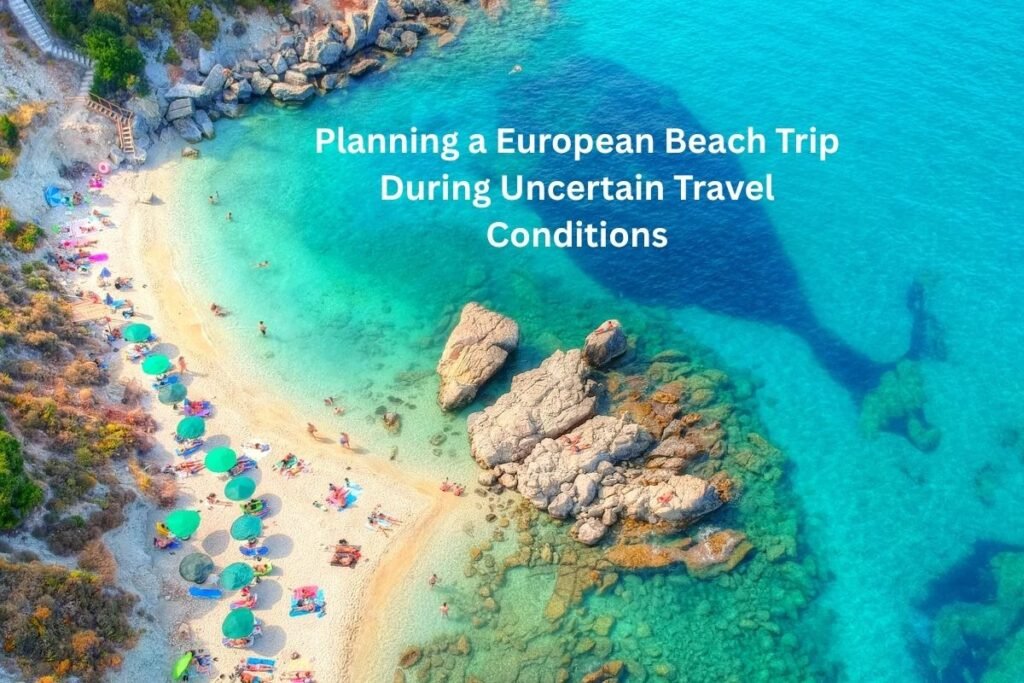
Travel uncertainty does not mean you must abandon your vacation. It means you should plan more intelligently. A coastal itinerary can actually provide useful flexibility when designed properly.
Instead of booking:
One long-haul flight → tight connection → remote destination → prepaid transfers
consider:
International arrival → one flexible overnight stay → regional connection the following day
This approach can reduce stress if your first flight arrives late. Maintaining healthy eating habits while traveling can also be easier with the right beverage choices, so travelers may want to explore our guide to Best Gut Health Sodas for convenient options.
Good practices for beach travelers
- Avoid same-day tight connections to ferries or small islands.
- Arrive one day before a nonrefundable cruise or tour when practical.
- Choose accommodations with transparent cancellation policies.
- Check seasonal weather patterns before booking.
- Have a backup inland destination if coastal transport is disrupted.
If you are comparing destinations based on beach access, nearby towns, and practical travel planning, find beaches near popular destinations with Beach Near.
Food planning can also make an unfamiliar destination easier. Travelers who want to research dining options can explore restaurant and food guides on Restaurent.net before building their itinerary. If you enjoy discovering unique culinary experiences while traveling, you can also explore our guide to Most Expensive Food to see some of the world’s most luxurious dining options.
When Should You Postpone a Trip?
Postponement may make sense when there is a verified and significant problem that directly affects your trip.
Consider postponing if:
- Your destination is officially closed to visitors.
- Your airline cannot reasonably rebook you.
- A serious emergency has made your planned route unsafe.
- You cannot meet the required entry conditions.
- Your passport or travel authorization is not valid.
- A major transportation disruption makes the trip impractical.
However, do not postpone solely because of an unclear headline.
First, determine:
- Is the problem real?
- Is it current?
- Does it affect my nationality?
- Does it affect my destination?
- Does it affect my exact travel date?
- Is there a practical alternative?
Final Thoughts
The phrase Europe freezes US travel sounds definitive, but travel reality is usually more complicated. A dramatic headline may describe a weather emergency, a temporary transportation disruption, a new border procedure, a country-specific policy, or political developments rather than a blanket ban on American tourists.
For travelers, the best response is verification—not panic. Identify the exact destination, check official entry requirements, understand the difference between EES and ETIAS, review your passport status, and monitor your airline and transit points. If disruption occurs, flexible planning and reliable documentation can make a major difference.
Europe remains a diverse collection of destinations, each with its own travel considerations. Whether you are planning a first European vacation, a business trip, or a coastal escape, focus on the rules and conditions that actually apply to your itinerary. Accurate preparation is more useful than reacting to a headline, and checking official sources shortly before departure remains the safest approach.
Frequently Asked Questions
Q01. Has Europe banned Americans from traveling there?
Ans: A broad Europe-wide ban should not be assumed from the phrase “Europe freezes US travel.” U.S. citizens should check the official entry rules for their specific destination and travel date.
Q02. Can Americans still visit Europe without a visa?
Ans: For eligible short stays in covered countries, U.S. citizens generally continue to benefit from visa-free travel, subject to applicable rules. Requirements can differ based on destination and purpose of travel.
Q03. What is ETIAS?
Ans: ETIAS is an electronic travel authorization for eligible visa-exempt travelers. Europe freezes US travel. It is not a visa and is scheduled to begin in the last quarter of 2026, with the exact launch date to be officially announced.
Q04. Do Americans need ETIAS right now?
Ans: As of August 2026, the official EU ETIAS website states that ETIAS has not yet started operations and that travelers do not need to take action until its official launch.
Q05. What is EES?
Ans: The Entry/Exit System is a digital system that records information about eligible Europe freezes US travelers entering and leaving participating Schengen countries for short stays. It includes biometric procedures where applicable.
Q06. Does EES mean Americans can no longer travel freely in Europe?
Ans: No. EES changes border procedures. Europe freezes US travel. It does not, by itself, end eligible visa-free short-stay travel.
Q07. Does every European country use the same travel rules?
Ans: No. Europe contains countries with different immigration and border systems. Always check the rules for your destination and any transit countries. Europe freezes US travel.
Q08. How long can an American stay in the Schengen Area?
Ans: For eligible visa-free short stays, the general rule is up to 90 days in any rolling 180-day period. Europe freezes US travel. Individual circumstances can differ, so long-term or complex travel should be checked carefully.
Q09. Should I cancel my European vacation because of a travel headline?
Ans: Not until you verify the source and determine whether the issue affects your specific destination, dates, flights, and nationality.
Q10. What should I do if my European flight is canceled?
Ans: Check the airline’s official app or website, explore rebooking options, keep receipts and records, and review the passenger rights and insurance coverage applicable to your itinerary.
Q11. How can I avoid fake ETIAS websites?
Ans: Use the official European Union ETIAS channels rather than responding to unsolicited messages or paying unfamiliar third-party websites.
Q12. What is the best way to stay updated before traveling?
Ans: Check official government, EU, airline, airport, and destination authority sources shortly before departure. Conditions can change after you book.