 -by
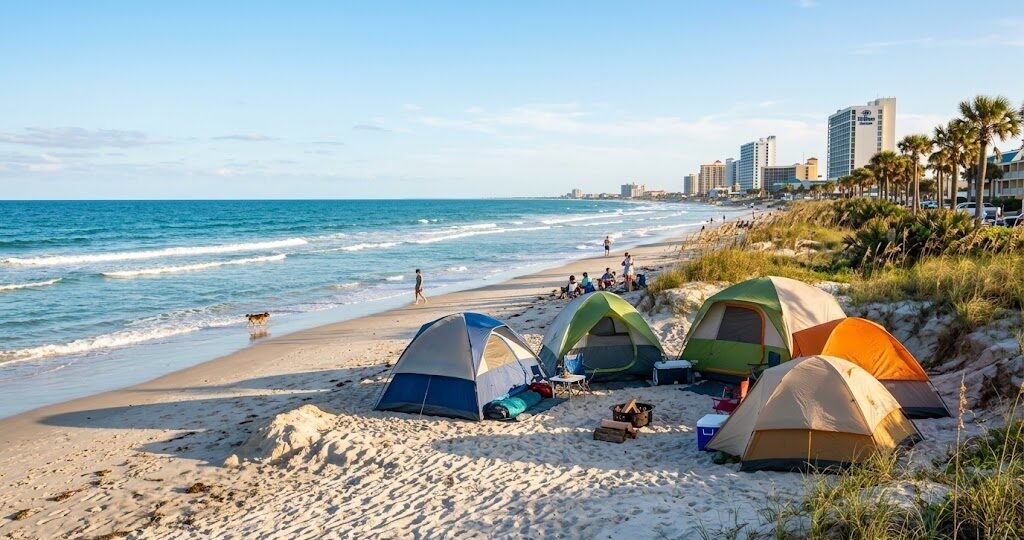
-by If you are searching for Daytona Beach camping on the beach, there is one important distinction to understand before you pack your tent: sleeping directly on the public sand at Daytona Beach is not the same as staying at a legal beachfront campground or oceanfront RV park. In the Daytona area, the best legal options are campgrounds that sit beside the Atlantic Ocean, provide direct or easy beach access, or place you within a short drive of the shoreline.
That distinction matters because beach rules, vehicle access, pets, fires, and overnight camping are controlled by different authorities. Volusia County, Florida State Parks, municipalities, and private campgrounds can all have different regulations.
This 2026 guide explains what beach camping around Daytona actually looks like, where to stay, what rules to expect, which campground fits different travelers, how to prepare for Florida’s coastal conditions, and what to do if your dream is to wake up beside the ocean 2026 accuracy note: Campground availability, fees, closures, access rules, and beach conditions can change. Always verify the current status directly with the campground or managing agency before traveling.
Can You Camp Directly on Daytona Beach?
No—do not assume that you can pitch a tent and spend the night directly on the public Daytona Beach sand. Public beach access does not automatically mean overnight camping is permitted. Instead, travelers looking for a beachfront camping experience should use a designated campground or private oceanfront RV facility.
This is one of the biggest misunderstandings surrounding Daytona Beach camping. Daytona is famous for its broad Atlantic shoreline and vehicle-accessible beach areas. However, driving onto a beach is not permission to sleep there. Volusia County’s beach rules regulate vehicle use, speed, parking, pets, alcohol, and other activities.
So, if your goal is to:
- Sleep in a tent near the ocean
- Park an RV beside the beach
- Wake up to an Atlantic Ocean view
- Walk directly from your campsite to the sand
You should search for a designated campground or private RV resort, rather than treating the public beach as an overnight campsite. That small planning decision can prevent a frustrating trip.
What Does Beach Camping Near Daytona Beach Actually Mean?
Beach camping generally means spending the night at a designated campsite close to the ocean, often with direct beach access or an ocean view. It can include tent camping, RV camping, primitive camping, or full-hookup RV sites, depending on the property.
For Daytona travelers, there are several different experiences:
| Camping style | What you get | Best for |
| Direct oceanfront RV camping | RV site beside the beach | RV travelers |
| Beachside campground | Campsite near dunes and beach | Tent + RV campers |
| Nearby state park camping | Nature setting plus beach access | Nature lovers |
| Inland campground | Camping within a short drive of beach | Budget travelers |
| Primitive camping | Few facilities and more self-reliance | Experienced campers |
The most important point is that “beachfront” does not always mean “camp directly on the sand.”A campground can be oceanfront while keeping campsites behind a dune system. In fact, that arrangement is often preferable because dunes protect coastal ecosystems and help separate camping areas from waves, wind, and shifting sand.
Best Beachfront Camping Options Near Daytona Beach in 2026
For travelers who specifically want the ocean nearby, the strongest options are not all inside Daytona Beach city limits. One particularly notable choice is Coral Sands RV Resort in Ormond Beach, north of Daytona. For campers wanting a true oceanfront RV experience, it deserves serious consideration.
01. Coral Sands RV Resort — Best for Oceanfront RV Camping
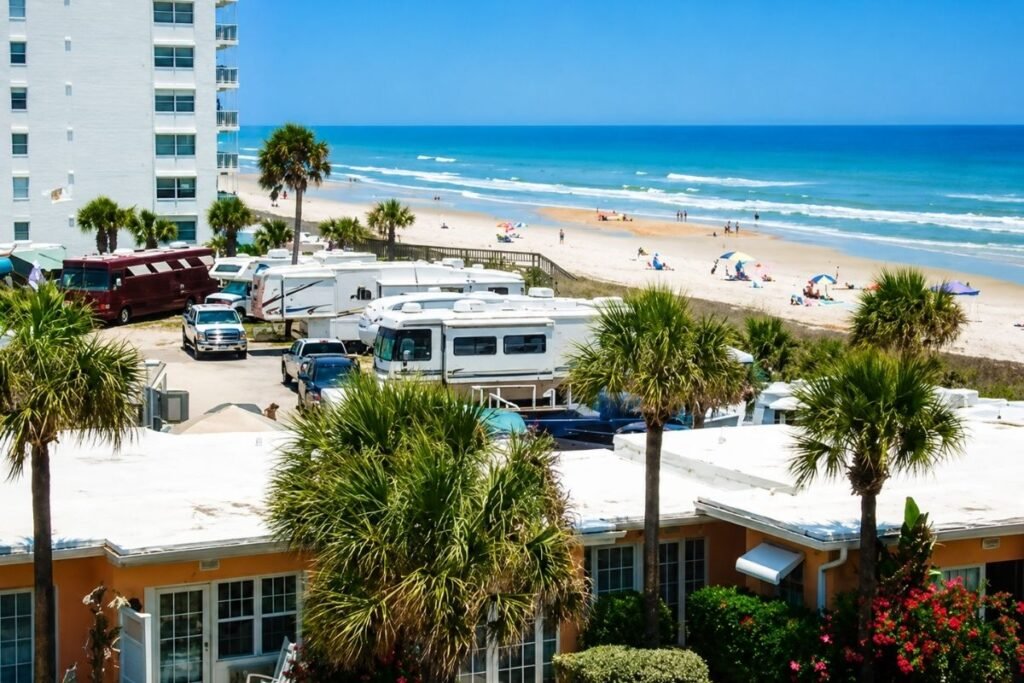
If your priority is putting an RV as close to the Atlantic as possible, Coral Sands is one of the most relevant choices around Daytona. The resort’s current RV information says it has 33 RV sites, with 20-, 30-, and 50-amp service, plus water and sewer hookups. Guests also have access to resort amenities including an oceanfront heated pool, laundry facilities, and Wi-Fi. The property sits directly on the beach in Ormond Beach and describes its shoreline as traffic-free.
Why choose it:
- Direct beach setting
- Full RV hookups
- 20/30/50-amp electrical service
- Water and sewer
- Oceanfront pool
- Laundry
- Wi-Fi
- Beach access
Best for: RV travelers, couples, families with RVs, and anyone who values location over primitive camping.
Important limitation: This is primarily an RV camping experience. If you want to put a traditional tent directly beside the Atlantic, this is not the same thing as primitive tent camping on a remote beach.
02. Gamble Rogers Memorial State Recreation Area — A True Beachside Camping Experience
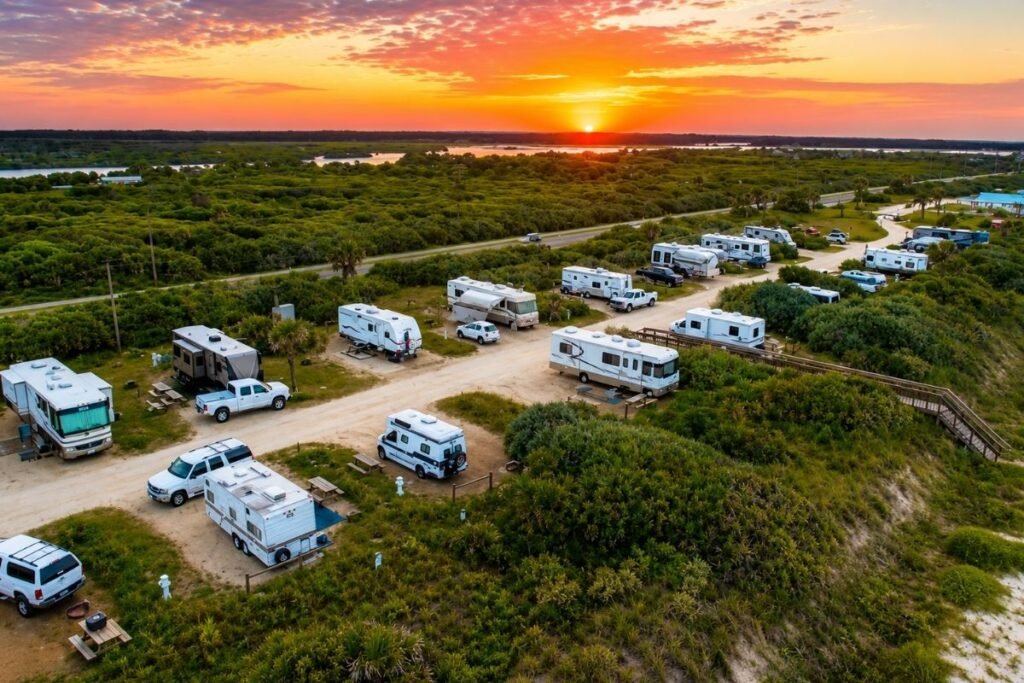
Gamble Rogers Memorial State Recreation Area at Flagler Beach. Gamble Rogers is one of the most important nearby options to understand because it offers a genuine beachside campground rather than simply a campground somewhere in the Daytona region. Florida State Parks says the campground has 34 sites on the primary beach dune and 34 on the riverside. Some beachside sites offer Atlantic Ocean views, while dune walkovers provide beach access without cutting through the fragile dune system.
The campsites have:
- Water
- Electricity
- Picnic tables
- Fire rings
- Restroom and shower facilities
- Dump station
- Tent camping
- RV camping
However, there is a major 2026 issue. The Florida State Parks website currently states that, effective June 23, 2026, the beachside campground, day-use parking lot, and restroom at Gamble Rogers are closed for an improvement project. That means you should not plan a 2026 beach-camping trip here without first confirming the current reopening status.
This is exactly why checking official park information shortly before departure is more reliable than relying on an older camping article or social-media post. When the beachside campground is available again, it is one of the most attractive choices near Daytona for travelers who want a traditional campground beside the Atlantic.
03. Tomoka State Park — Best for Nature + Camping
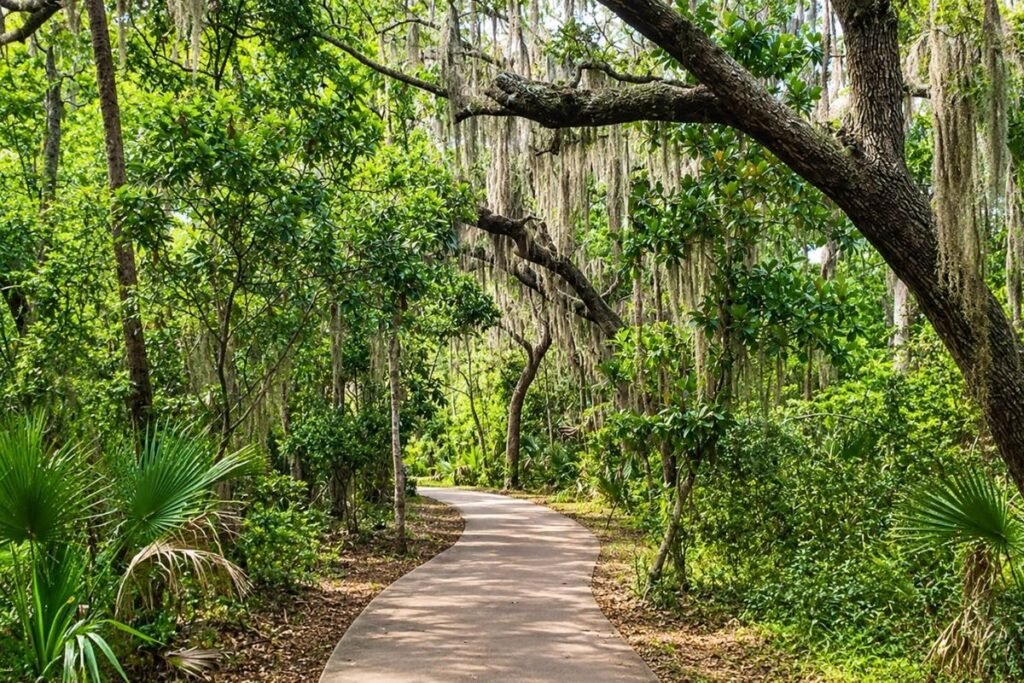
Tomoka State Park is not an oceanfront campground, so it should not be marketed as direct beach camping. However, it is a useful alternative for people who want camping near Daytona’s beaches while also enjoying a more natural park environment. The park sits along the Tomoka River and offers full-facility campsites in a shady hammock. Florida State Parks lists 100 campsites, each with a picnic table, grill, electricity, and water. There is also a dump station and bathhouses with hot showers.
The park also supports:
- Canoeing
- Boating
- Fishing
- Hiking
- Bicycling
- Wildlife viewing
- Camping
The maximum RV length listed by Florida State Parks is 34 feet. For travelers who don’t need to see the ocean from the campsite, Tomoka can be a better overall camping environment than a tightly packed beachfront RV site. Current listed camping fees are $24 per night plus tax, along with reservation and applicable utility fees. Because prices can change, verify the total at booking.
04. International RV Park & Campground — Practical Daytona Base
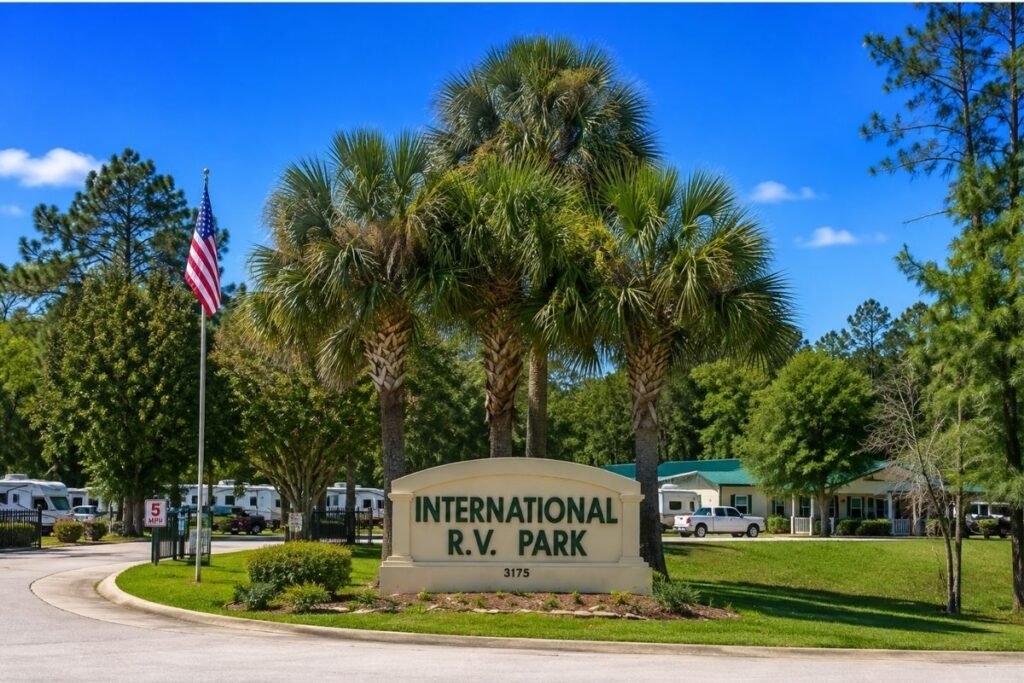
If being directly beside the ocean is less important than having a practical base for exploring Daytona, International RV Park & Campground is another option.
Its official site lists:
- Wi-Fi
- Store
- Laundry
- Pool
- Bathhouse
- Clubhouse
- Pet-friendly accommodations
The campground is at 3175 W. International Speedway Blvd., putting you inland rather than on the shoreline. The campground also publishes detailed rules, including quiet hours from 11 p.m. to 8 a.m., six-foot pet leashes, no unauthorized ground fires, and restrictions on fireworks and glass containers.
Best for: RV travelers who want facilities, convenience, and access to Daytona attractions.
Not best for: Someone whose main goal is stepping out of the tent or RV directly onto an oceanfront beach.
Daytona Beach Camping Comparison: Which Option Fits You?
Choosing a campground becomes much easier when you identify the experience you actually want.
| Option | Oceanfront? | Tent camping | RV camping | Full hookups | Best use |
| Coral Sands RV Resort | Yes | Not the main focus | Yes | Yes | Oceanfront RV stay |
| Gamble Rogers | Beachside | Yes | Yes | Water/electric | Beachside camping |
| Tomoka State Park | No | Yes | Yes | Yes | Nature-focused camping |
| International RV Park | No | Available | Yes | Yes | Convenient Daytona base |
| Canaveral National Seashore | No beach camping | No beach camping | No vehicle camping | No | Primitive island camping |
The last option deserves special attention because many people searching for Florida beach camping find Canaveral National Seashore and assume they can camp on its beaches.
Can You Camp on the Beach at Canaveral National Seashore?
No. Beach camping is not permitted at Canaveral National Seashore. The National Park Service allows designated primitive camping on islands in Mosquito Lagoon, but this is a completely different experience from sleeping on the Atlantic beach. The park currently has 14 designated backcountry island campsites, and reservations plus permits are required.
Campers must reach the sites using their own watercraft, with limited canoe rentals available for certain sites. The NPS explicitly states that beach camping is not permitted. So if you are willing to trade an oceanfront campsite for a remote paddling adventure, island camping can be interesting.
But if your goal is:
“I want to sleep on the Atlantic beach near Daytona,” this is not the answer.
What Are the Daytona Beach Camping Rules?
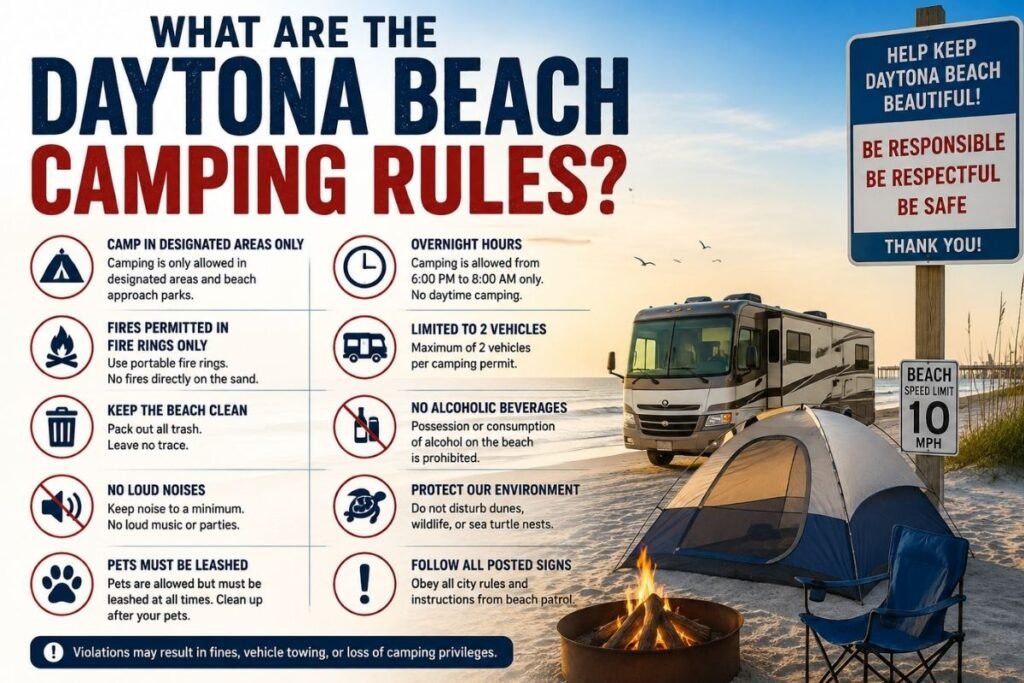
Understanding local beach rules is essential because Daytona’s coastline is unusual in allowing certain vehicle access.
Volusia County says beach drivers must:
- Drive with headlights on
- Keep at least one front window completely open
- Obey the 10 mph speed limit
- Avoid texting while driving
- Follow posted parking restrictions
The county also says alcohol and glass containers are not allowed on its beaches, and pets are not allowed on the beach except qualifying service animals.
Does Driving on Daytona Beach Mean You Can Camp There?
This is one of the most important distinctions for visitors. Beach driving is a transportation and recreation privilege governed by local rules. Overnight camping is a separate activity and requires authorization from the appropriate campground or land manager. Never assume that parking your RV on the beach after dark is equivalent to reserving a campsite.
Can You Have a Campfire on Daytona Beach?
Do not assume that you can build a campfire on the public beach. Fire rules depend on the specific location and current conditions. Designated campgrounds may provide fire rings, while public beach areas can have different restrictions. For example, Gamble Rogers’ campsites provide fire rings, while International RV Park publishes a rule against unauthorized ground fires and advises campers to check with management regarding fire restrictions.
The safest approach is simple:
- Use only an approved fire ring or designated cooking area.
- Check current fire restrictions.
- Never build a fire directly in sensitive dune vegetation.
- Completely extinguish permitted fires.
- Follow campground-specific rules even if you have camped elsewhere in Florida.
Are Dogs Allowed at Daytona Beach Campgrounds?
This depends on where you stay. Volusia County’s public beach rules generally prohibit pets on the beach except qualifying service animals. At campgrounds, however, pets may be permitted in designated areas. For example, Gamble Rogers allows pets in the campground but prohibits them on the beach. Private campgrounds can establish their own rules. International RV Park, for example, requires pets to remain on a leash no longer than six feet and requires owners to clean up after them.
Therefore, if you’re bringing a dog, ask two separate questions:
“Are pets allowed at the campground?”
and
“Are pets allowed on the beach?”
Those answers may be completely different.
What Should Beginners Bring for Daytona Beach Camping?
Florida coastal camping requires a slightly different packing strategy than mountain or forest camping.
Essential Gear
Pack:
- Tent or RV equipment appropriate for wind
- Sleeping bag or lightweight bedding
- Sleeping pad
- Portable fan
- Headlamp
- Extra batteries or power bank
- Water bottles
- Cooler
- Food-storage containers
- Sunscreen
- Sunglasses
- Wide-brimmed hat
- Insect repellent
- Quick-dry clothing
- Rain jacket
- Beach towel
- Sand-resistant footwear
- First-aid kit
- Personal medications
- Waterproof storage bags
For tent campers, wind protection is especially important. A beautiful beach campsite can become uncomfortable very quickly when wind blows sand beneath a poorly secured tent.
How Do You Protect Your Tent From Wind and Sand?
Beach-adjacent camping requires more attention to setup than a sheltered forest campsite.
01. Use appropriate tent stakes
Standard lightweight stakes may not hold well in loose sand. Use equipment designed for sandy or soft ground and follow the tent manufacturer’s setup recommendations.
02. Keep the tent low and secure
Use every available guyline when conditions are windy.
03. Avoid fragile dune vegetation
Do not choose your own shortcut through dunes. Use designated walkovers and paths.
04. Protect sleeping equipment
Keep bags and clothing inside sealed containers when you’re not using them.
05. Expect moisture
Atlantic humidity can make clothing, towels, and gear feel damp even when it isn’t raining. A dry bag or waterproof storage container can make the trip much easier.
When Is the Best Time for Beach Camping Near Daytona?
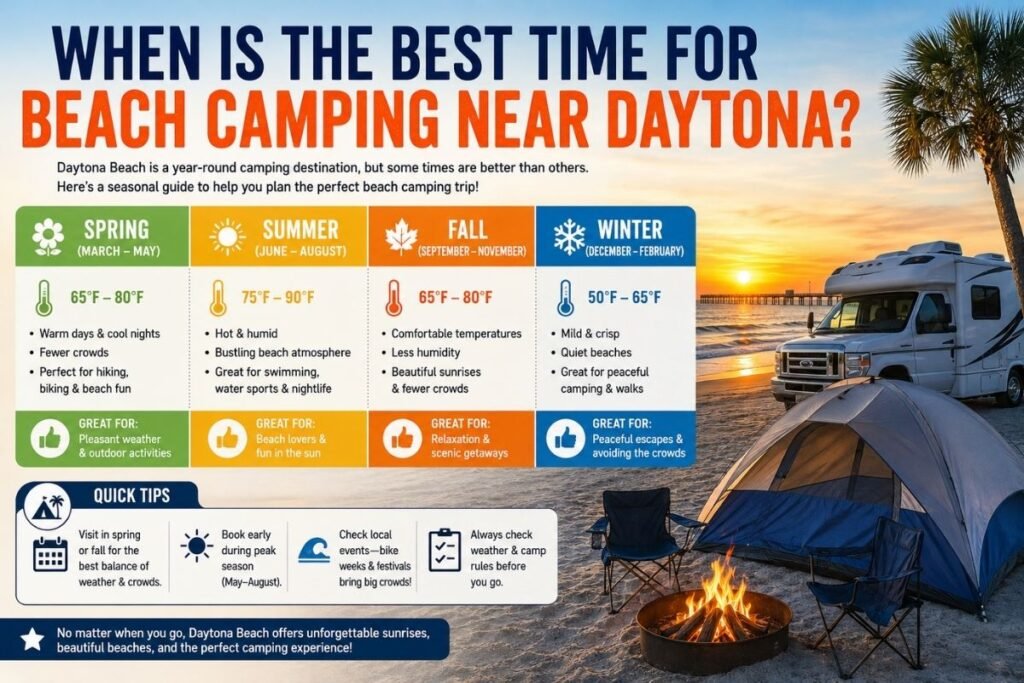
There isn’t one perfect season for everyone.
Spring
Spring can offer a comfortable balance of outdoor temperatures and manageable crowds. However, popular weekends and special events can become busy.
Summer
Summer delivers the classic Florida beach experience, but heat, humidity, thunderstorms, insects, and heavy visitor traffic can make camping more demanding. For tent campers, afternoon heat is an important consideration.
Fall
Fall can be attractive for travelers who prefer a quieter atmosphere. However, Florida’s Atlantic coast remains exposed to tropical weather risks during hurricane season. Always check the forecast before departure.
Winter
Winter is particularly appealing to travelers escaping colder northern climates. RV parks can become popular with seasonal visitors, so availability may be tighter.
The best season therefore depends on your priority:
| Priority | Consider |
| Warm beach days | Late spring through summer |
| Cooler camping conditions | Winter |
| Potentially quieter atmosphere | Fall or selected winter dates |
| Avoiding extreme heat | Winter or shoulder seasons |
| RV seasonal travel | Book well ahead |
Weather should always take priority over a reservation. If tropical weather or dangerous surf threatens the coast, changing your plans is the sensible decision.
What Are the Biggest Mistakes First-Time Beach Campers Make?
Even experienced campers can make mistakes near the ocean.
Mistake 01: Assuming public beach access means overnight camping
It doesn’t. Confirm that the exact property allows overnight camping.
Mistake 02: Booking the wrong type of campsite
“Beachfront,” “beachside,” “ocean view,” and “near beach” can mean very different things. Read the actual campsite description before paying.
Mistake 03: Ignoring wind
A tent that works beautifully in a protected campground may struggle in exposed coastal conditions.
Mistake 04: Forgetting the humidity
Cotton clothing, towels, and bedding can remain damp.
Mistake 05: Bringing too much food
Food attracts insects and wildlife. Store it securely and follow campground rules.
Mistake 06: Walking over dunes
Dunes are not empty piles of sand. They are part of the coastal protection system and provide habitat for wildlife.
Mistake 07: Not checking closures
This is particularly important in 2026 because Gamble Rogers’ beachside camping facilities are currently listed as closed for an improvement project.
How Can You Protect Daytona’s Coastal Environment?
Responsible camping is more than picking up your own trash. Beach and dune ecosystems are vulnerable to disturbance.
Follow these principles:
- Stay on designated paths.
- Use dune walkovers.
- Pack out trash.
- Don’t bury waste.
- Don’t disturb nesting wildlife.
- Don’t collect protected wildlife or natural resources where prohibited.
- Keep lights controlled near sensitive areas.
- Keep food secured.
- Respect campground quiet hours.
- Follow fire restrictions.
Sea turtles are particularly important along Florida’s Atlantic coast. Gamble Rogers notes that sea turtles can nest on its beach during the warmer months. That means nighttime beach behavior matters. If you’re camping near a nesting beach, check current wildlife guidance and avoid unnecessary lighting or disturbance.
Beach Camping vs. Oceanfront RV Camping: Which Is Better?
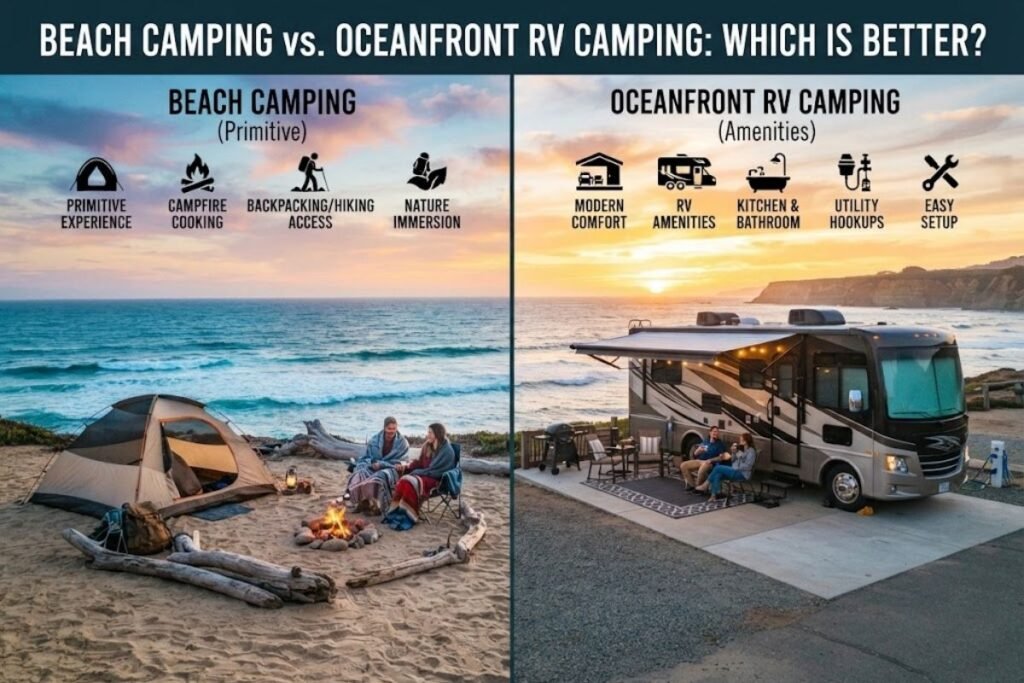
These experiences appeal to different travelers.
Traditional beachside camping
Pros
- More immersive
- Usually better for tent campers
- Strong connection with nature
- Easier to combine camping with hiking and beach activities
Cons
- More exposed to weather
- Sand gets everywhere
- Less privacy
- Facilities may be basic
Oceanfront RV camping
Pros
- Electricity and water
- Comfortable sleeping
- Easy access to showers
- Better for longer stays
- Excellent for families and road trips
Cons
- More expensive than basic tent camping
- Requires an RV
- Less primitive
- Availability can be limited
If your ideal morning involves coffee outside your RV while looking toward the Atlantic, choose an oceanfront RV resort. If you want to hear the ocean while sleeping in a tent and don’t mind dealing with wind and sand, look for a designated beachside campground when one is open.
How Far Should You Stay From the Water?
Even when camping near the ocean, do not try to place your tent at the edge of the shoreline. The beach changes with tides, storms, wind, and erosion. Designated campgrounds place overnight sites in areas selected and managed for camping. That is safer than choosing your own location. In addition, dune systems can provide an important buffer between ocean and campground. The right mindset is: Camp near the beach, not on an unstable section of beach.
How Far in Advance Should You Book?
For popular Florida campgrounds, earlier is generally better, especially for:
- Winter travel
- Holiday weekends
- School vacations
- Major Daytona events
- Large RVs
- Oceanfront sites
- Premium sites with ocean views
Florida State Parks says reservations at Gamble Rogers can be made up to 11 months in advance when the campground is operating. Private oceanfront RV properties can have their own booking windows and cancellation policies.
For a specific trip, check:
- Your exact dates
- Site type
- RV length
- Electrical requirements
- Pet policy
- Cancellation policy
- Current closure notices
What About Daytona’s Major Events?
Daytona Beach is not just a beach destination. It is also famous for motorsports events. That can dramatically affect campground demand. If you’re visiting during a major event at Daytona International Speedway, don’t treat the trip like a normal beach weekend. Campgrounds near the speedway can become part of the event accommodation market, while oceanfront properties can also fill quickly. For a peaceful camping trip, check the local event calendar before booking. For a motorsports-focused trip, proximity to the speedway may matter more than being beside the ocean.
That’s an important trade-off:
Beach trip → prioritize shoreline access.
Race/event trip → prioritize location and transportation.
A Simple 3-Day Daytona Beach Camping Plan
If this is your first camping trip to the area, keep the itinerary simple.
Day 1: Settle In
Arrive during daylight.
Set up camp before sunset.
Then:
- Walk to the beach
- Check local conditions
- Learn your campground’s rules
- Prepare dinner
- Watch sunset
- Secure food and belongings
Don’t make your first evening overly ambitious.
Day 2: Beach + Exploration
Start early.
Enjoy:
- Sunrise
- Beach walk
- Swimming where conditions permit
- Surf fishing where legal
- Local breakfast
- Daytona attractions
- Afternoon rest
- Evening campground meal
Early mornings are especially useful because they let you enjoy the shoreline before the day’s heat builds.
Day 3: Slow Morning
Have breakfast at camp. Pack gradually. Take one last beach walk.
Check your campsite carefully for:
- Food
- Trash
- Tent stakes
- Charging cables
- Children’s toys
- Fishing equipment
- Personal items
A final campsite inspection prevents the classic “I left something at the beach” problem.
What Should Professionals and Experienced Campers Consider?
Experienced travelers may focus less on basic gear and more on operational details.
RV travelers
Check:
- Maximum RV length
- Turning radius
- Site width
- Amp service
- Water connection
- Sewer connection
- Dump station
- Generator rules
- Towing vehicle requirements
Tomoka, for example, lists a maximum RV length of 34 feet, while Gamble Rogers lists a maximum beach-site RV length of 47 feet. Those differences matter when planning a large motorhome.
Remote campers
For primitive island camping at Canaveral National Seashore, you need to think about:
- Watercraft
- Weather
- Navigation
- Emergency planning
- Food storage
- Waste management
- Communication
- Tides and waterways
The NPS recommends preparation for water travel, emergency equipment, personal flotation devices, and weather conditions. This is not a casual alternative to an RV campground.
Useful Daytona Beach Travel Planning Resources
For broader beach-trip planning, you can also explore beach guides and coastal getaway ideas on Beach Near. For example, Beach Near publishes guides covering U.S. beaches, closest-beach planning, and family beach destinations. For regulations, always prioritize the managing authority over a third-party travel article.
Useful official resources include:
- Volusia County beach rules
- Florida State Parks
- Tomoka State Park
- Gamble Rogers State Recreation Area
- National Park Service — Canaveral National Seashore
Conclusion
Daytona Beach is a fantastic destination for travelers who want beach camping combined with a memorable coastal getaway. However, successful beach camping starts with understanding the difference between camping directly on the sand and staying at a campground near the beach. Before planning your trip, always check current rules, closures, and reservation requirements.
For RV travelers seeking an oceanfront experience, Coral Sands RV Resort in nearby Ormond Beach can be a convenient option for coastal beach camping. Travelers who prefer a traditional tent or RV setting near the dunes may consider Gamble Rogers. However, its beachside camping facilities are currently listed as closed for an improvement project in 2026, so verify its status before visiting.
For a quieter nature experience, Tomoka State Park offers campground facilities within easy reach of the coast. Meanwhile, Canaveral National Seashore provides designated primitive island camping for adventurous travelers, although it should not be confused with legal beach camping.
Ultimately, Daytona is well suited to beach camping when you plan carefully. Choose an authorized campsite, follow local regulations, prepare for wind and humidity, and protect fragile dunes. Responsible beach camping helps preserve the coastline while giving you a relaxing and unforgettable coastal adventure. Always remember that public beach access does not automatically permit overnight beach camping.
Frequently Asked Questions
Q1. Can you camp directly on Daytona Beach?
Ans: Generally, you should not assume that public beach areas in Daytona allow overnight beach camping. Beach driving access and overnight camping are separate activities, and each follows different regulations. For a legal beach camping experience, choose a designated campground, state park, or private RV resort that specifically allows overnight stays. Checking current local rules before your trip can help you avoid fines and unexpected problems.
Q2. Is there beachfront camping near Daytona Beach?
Ans: Yes, the Daytona Beach area has options for travelers looking for beach camping close to the ocean. Coral Sands RV Resort in nearby Ormond Beach offers an oceanfront RV experience, while Gamble Rogers has historically provided tent and RV campsites near the beach. However, Gamble Rogers’ beachside campground is currently listed as closed for an improvement project effective June 23, 2026. Always verify current availability before planning beach camping there.
Q3. Can I sleep in my RV on Daytona Beach?
Ans: You should never assume that driving an RV onto the beach automatically permits overnight beach camping. Beach vehicle access does not necessarily include permission to sleep or park overnight. Instead, book an authorized RV campground or resort. This approach makes your beach camping trip safer, more comfortable, and compliant with local regulations.
Q4. Is Coral Sands RV Resort actually on the beach?
Ans: Yes. Coral Sands RV Resort describes its RV sites as being directly on the beach. This makes it particularly appealing for travelers seeking convenient oceanfront beach camping without giving up RV amenities. Depending on the site, guests can enjoy full hookups and resort facilities while staying close to the Atlantic shoreline. It is a strong option for RV-focused beach camping near Daytona.
Q5. Is Gamble Rogers good for tent camping?
Ans: When its beachside campground is operating, Gamble Rogers is a popular choice for traditional beach camping. The park has historically offered both tent and RV camping, with sites positioned close to the beach and riverside areas. Campers should check the latest park status before making beach camping plans because temporary closures or improvement projects can affect availability.
Q6. Can I bring my dog beach camping?
Ans: Pet policies depend on the location. Volusia County generally prohibits pets on the public beach, except for qualifying service animals, while individual campgrounds may allow pets in designated areas. If you plan beach camping with a dog, review both the campground’s pet policy and local beach regulations. Following these rules helps make beach camping enjoyable for everyone.
Q7. Can I have a campfire at a Daytona campground?
Ans: Campfires are allowed only in locations and under conditions approved by the campground or park. Some designated campsites provide fire rings, while unauthorized fires on beaches or other areas may be prohibited. Before starting a fire during beach camping, check posted regulations and local restrictions, especially during dry or windy conditions.
Q8. Is Tomoka State Park beachfront?
Ans: No. Tomoka State Park is primarily a riverside nature destination rather than an oceanfront campground. However, its location makes it a useful base for visitors who want camping facilities while remaining relatively close to Daytona’s beaches. It can be a practical alternative for travelers seeking a nature-focused trip instead of direct beach camping.
Q9. Can you beach camp at Canaveral National Seashore?
Ans: No. Visitors should not confuse primitive island camping with beach camping at Canaveral National Seashore. The park offers designated primitive island camping in Mosquito Lagoon, subject to reservations and permits, but overnight camping directly on the beach is not permitted. Understanding this distinction is important when planning a legal beach camping adventure.
Q10. What is the best campground for an RV with an ocean view?
Ans: For travelers who prioritize an oceanfront RV experience, Coral Sands RV Resort is one of the strongest options near Daytona. Its official information describes direct beach placement, full hookups, and oceanfront amenities. For visitors who want comfortable beach camping with RV conveniences, it offers a convenient combination of coastal scenery and campground facilities. Always confirm current site availability, rules, and seasonal conditions before your beach camping trip.