
 -by
-by Travel plans can look simple on the surface: book a flight, reserve accommodation, arrange activities, and pack your bags. The financial risk, however, can be much less predictable. A medical emergency abroad, cancelled trip, missed connection, stolen belongings, or emergency evacuation can turn an otherwise enjoyable vacation into an expensive problem.
The best travel insurance is therefore not necessarily the cheapest policy or the one with the longest list of benefits. It is the policy that matches your destination, trip cost, health circumstances, activities, and tolerance for financial risk.
This guide explains what travel insurance actually covers, which benefits matter most, how to compare policies, what exclusions deserve attention, and when specialist or annual coverage may make more sense. It also explains important differences between trip cancellation insurance, travel medical insurance, medical evacuation coverage, and optional protections such as Cancel For Any Reason.
Because insurance rules and policy terms vary by country and provider, always read the current policy wording before purchasing. Official travel guidance from the U.S. Department of State and CDC recommends travelers consider appropriate medical and evacuation coverage, while consumer guidance emphasizes checking exclusions, limits, excesses, and pre-existing medical conditions.
What Is Travel Insurance?
Travel insurance is a policy designed to protect travelers against specified financial losses and emergencies associated with a trip. Depending on the plan, it may cover emergency medical treatment, medical evacuation, trip cancellation or interruption, travel delays, lost or stolen baggage, personal liability, and other risks.
The important word is specified. Insurance does not automatically cover every problem that occurs while traveling. Each policy has eligibility requirements, coverage limits, exclusions, deductibles or excesses, and claim procedures.
That means choosing a policy should begin with the question:
What financial risks could seriously affect this particular trip, and does the policy actually cover them?
For an international vacation, medical and evacuation coverage may be more financially important than baggage protection. For an expensive prepaid cruise, cancellation and interruption benefits may deserve greater attention. For a skiing, diving, trekking, or motorbike trip, activity exclusions can become critical.
Why Travel Insurance Matters

Many travelers think of insurance primarily as protection against lost luggage. That is only one possible use. The more significant risks can involve medical care, evacuation, and non-refundable travel expenses.
The U.S. Department of State recommends considering travel health insurance and medical evacuation insurance for international travel because ordinary health insurance may not provide adequate overseas protection. It specifically notes that emergency medical evacuation can be extremely expensive.
Travel insurance can potentially help with:
- Emergency medical treatment
- Emergency dental treatment, depending on the policy
- Medical evacuation
- Repatriation
- Trip cancellation for covered reasons
- Trip interruption
- Travel delays
- Missed connections
- Lost, stolen, or damaged baggage
- Baggage delays
- Personal liability
- Certain emergency accommodation or transportation costs
- Some travel assistance services
The exact protection varies considerably between policies.
A simple example
Imagine that you book a non-refundable international vacation costing $4,000. Before departure, you experience a covered medical event that prevents you from traveling. A suitable cancellation benefit could potentially reimburse eligible prepaid, non-refundable expenses, subject to the policy’s conditions and limits.
Now consider a different situation: you become seriously ill during the trip and need emergency transportation to an appropriate medical facility. In this case, medical and evacuation coverage may matter much more than trip cancellation protection. This is why there is no universally perfect policy.
What Does the Best Travel Insurance Usually Cover?

A strong policy should be evaluated by coverage quality, not simply by the number of benefits advertised. Here are the major categories to examine.
01. Emergency Medical Coverage
For international travelers, emergency medical protection can be one of the most important components. Depending on the policy, it can cover eligible expenses such as:
- Emergency hospital treatment
- Doctor visits
- Emergency surgery
- Ambulance transportation
- Prescription medication associated with a covered emergency
- Emergency dental treatment
- Diagnostic services
- Other medically necessary emergency treatment
Coverage limits vary widely. Do not assume that a policy with a large headline medical limit covers everything.
Check:
- Maximum benefit
- Deductible or excess
- Eligible treatment
- Exclusions
- Whether pre-authorization is required
- Whether the insurer pays providers directly
- Whether you must pay first and claim reimbursement later
The CDC explains that travel disruption, travel health, and medical evacuation insurance can serve different purposes and should be considered separately when evaluating international travel protection.
Why medical coverage deserves priority
A relatively small baggage loss is inconvenient. A serious medical emergency can be financially devastating. For that reason, travelers should generally avoid choosing a policy simply because it has the lowest premium.
02. Emergency Medical Evacuation
Medical evacuation is different from ordinary medical treatment. Suppose you are injured in a remote area where appropriate treatment is unavailable. You may need transportation to another hospital or, depending on the circumstances and policy, transportation home. Some policies provide medical evacuation and repatriation benefits.
This coverage can be particularly important for:
- Remote destinations
- Island travel
- Adventure trips
- Mountain trekking
- Cruise holidays
- Rural travel
- Destinations with limited specialist healthcare
- Travelers participating in higher-risk activities
The U.S. Department of State specifically recommends considering medical evacuation insurance when traveling to places with higher risks or limited medical care.
Check the fine print
Do not look only at the evacuation dollar limit.
Check:
- Who decides whether evacuation is medically necessary
- Whether the insurer must approve evacuation
- Whether evacuation means transportation to the nearest appropriate facility or transportation home
- Whether repatriation is included
- Whether family-member transportation is covered
- Whether adventure activities are excluded
A high limit is useful only if the circumstances of your emergency qualify for coverage.
03. Trip Cancellation Coverage
Trip cancellation insurance can reimburse eligible prepaid, non-refundable trip expenses when you cancel for a covered reason.
Depending on the policy, covered reasons may include certain:
- Illnesses
- Injuries
- Deaths in the family
- Serious emergencies
- Natural disasters
- Travel restrictions
- Other specifically listed events
The key phrase is covered reason. Standard cancellation insurance does not normally mean:
“I can cancel for any reason and automatically get all my money back.” That is a common misunderstanding. If you simply change your mind, decide you no longer want to travel, or find a better vacation, a standard policy may not pay.
04. Trip Interruption Coverage
Cancellation happens before departure. Trip interruption generally applies after your journey has begun. For example, you might have to return home early because of a covered emergency.
Depending on the policy, eligible benefits could include:
- Unused prepaid travel expenses
- Additional transportation costs
- Additional accommodation
- Certain meals or necessary expenses
- Costs associated with returning home
Again, the exact definition matters. A policy may cover interruption for specific listed reasons but exclude voluntary changes.
05. Travel Delay Coverage
Travel delays can create unexpected expenses.
A delay benefit may help with eligible expenses such as:
- Meals
- Accommodation
- Local transportation
- Essential purchases
But policies often require a minimum delay period before benefits apply.
For example, one policy may begin benefits after six hours while another may require a longer delay. Do not compare the benefit without comparing the trigger.
06. Baggage and Personal Belongings
Baggage coverage can protect against certain losses involving:
- Lost luggage
- Stolen belongings
- Damaged baggage
- Delayed baggage
But baggage insurance often contains detailed conditions.
Check:
- Maximum total benefit
- Per-item limit
- Electronics limits
- Jewelry limits
- Documentation requirements
- Theft reporting requirements
- Depreciation rules
- Excluded items
A $2,000 baggage limit does not necessarily mean your $1,800 laptop is automatically covered for its full replacement value. There may be a much lower single-item limit.
Practical tip
If you are traveling with expensive electronics, cameras, jewelry, sports equipment, or specialist equipment, check the per-item limits before purchasing.
07. Personal Liability
Some travel insurance policies include personal liability protection. This may help if you become legally liable for certain covered injuries to another person or damage to another person’s property. However, liability exclusions can be extensive.
If you plan to drive abroad, do not assume ordinary travel insurance replaces appropriate vehicle liability insurance. The U.S. Department of State advises travelers to check their auto insurance and local requirements before driving internationally.
The Best Travel Insurance Depends on the Type of Trip

There is no single policy that is best for every traveler.
| Traveler or trip | Coverage to prioritize |
| First-time international traveler | Medical, evacuation, cancellation |
| Family vacation | Medical, cancellation, interruption, baggage |
| Luxury vacation | High cancellation limits, medical, evacuation |
| Backpacker | Medical, evacuation, interruption, flexible trip duration |
| Adventure traveler | Medical, evacuation, activity coverage |
| Cruise traveler | Medical, evacuation, interruption, missed connections |
| Frequent traveler | Annual multi-trip coverage |
| Senior traveler | Medical conditions, medical limits, evacuation |
| Business traveler | Medical, interruption, equipment, delay |
| Long-term traveler | Extended medical and evacuation coverage |
| Budget traveler | Strong medical coverage with only essential extras |
| Schengen visa applicant | Policy meeting current visa insurance requirements |
The table is a starting point, not a substitute for reading the policy. Before planning your itinerary around major tourist attractions, it’s also worth considering travel insurance to help protect your trip against unexpected cancellations, medical emergencies, delays, and other travel-related disruptions.
How to Choose the Best Travel Insurance: A Step-by-Step Method

Instead of starting with insurance companies, start with your trip.
Step 1: Calculate Your Financial Exposure
List the non-refundable costs you could lose.
Include:
- Flights
- Hotels
- Tours
- Cruise payments
- Rail tickets
- Rental vehicles
- Event tickets
- Prepaid activities
For example:
Trip cost
- Flights: $1,000
- Hotels: $1,200
- Cruise: $2,000
- Tours: $500
- Other prepaid costs: $300
Potentially exposed trip cost: $5,000
Your cancellation limit should be appropriate for the eligible non-refundable expenses you actually want protected. Do not insure costs that are already fully refundable.
If your trip includes fine dining or unique culinary experiences, it can also be helpful to explore the most expensive food in the world before planning your travel budget.
Step 2: Identify Your Destination
Destination can influence both the cost and importance of coverage.
Ask:
- Is healthcare expensive?
- Is specialist medical care easily available?
- Will I travel to remote areas?
- Are there political or security concerns?
- Is the destination prone to hurricanes, cyclones, earthquakes, or other hazards?
- Will I cross multiple countries?
- Will I need a visa with insurance requirements?
Never assume that one country’s travel insurance rules apply globally.
Step 3: Check Your Existing Insurance
Before purchasing another policy, review what you already have.
Possible sources include:
- Health insurance
- Credit cards
- Home insurance
- Employer benefits
- Existing annual travel insurance
- Airline or tour operator protection
Credit-card travel protection can be useful, but benefits vary significantly by card and may require you to purchase the trip using that specific card. Current consumer guidance also warns travelers to check exclusions, limits, and claim conditions rather than assuming card coverage is comprehensive. Avoid paying twice for identical protection while accidentally leaving major gaps elsewhere.
Step 4: Check Medical Conditions Carefully
Pre-existing medical conditions require particular attention. Do not assume that a condition is covered simply because the policy includes emergency medical treatment.
An insurer may have specific rules about:
- Diagnosed conditions
- Recent treatment
- Medication changes
- Hospitalization
- Ongoing symptoms
- Medical tests
- Undisclosed conditions
MoneyHelper advises travelers to provide accurate medical information because insurers may examine medical history when assessing a claim.
The safest approach
If the application asks about your medical history, answer accurately. If you are unsure whether something qualifies as a pre-existing condition, ask the insurer before buying. A cheaper policy that excludes an important medical condition may be poor value.
Step 5: Check Your Planned Activities
This is one of the most frequently overlooked areas. A policy may cover ordinary sightseeing but exclude or restrict activities considered higher risk.
Examples can include:
- Scuba diving
- Skiing
- Snowboarding
- Mountaineering
- Paragliding
- Motorbike riding
- Rock climbing
- Certain water sports
Do not assume that “adventure travel” is automatically included. The U.S. Department of State specifically advises travelers to ensure insurance covers planned activities and special risks. If you are planning a beach vacation involving diving, snorkeling, jet skis, boat trips, or other activities, check each activity against the policy wording.
For destination planning, Beach Near’s Thailand Travel Guide also highlights travel insurance alongside activities such as ferries, diving, and motorbike travel. If you’re planning a trip and want to enjoy authentic flavors along the way, don’t forget to explore some of the best Thai street food before or after your travels.
Step 6: Compare Coverage Limits
Price should come after coverage. Create a simple comparison:
| Benefit | Policy A | Policy B | Policy C |
| Emergency medical | Check limit | Check limit | Check limit |
| Medical evacuation | Check limit | Check limit | Check limit |
| Cancellation | Check limit | Check limit | Check limit |
| Interruption | Check limit | Check limit | Check limit |
| Baggage | Check limit | Check limit | Check limit |
| Delay | Check trigger | Check trigger | Check trigger |
| Adventure activities | Included? | Included? | Included? |
| Pre-existing conditions | Terms | Terms | Terms |
| Excess/deductible | Amount | Amount | Amount |
| 24/7 assistance | Yes/No | Yes/No | Yes/No |
This makes differences much easier to see.
Step 7: Read Exclusions Before Buying
The exclusions may be more important than the marketing page.
Look for exclusions involving:
- Pre-existing medical conditions
- Alcohol or drug-related incidents
- Unapproved activities
- Travel against government advice
- Unattended belongings
- Certain natural disasters
- Pandemics or epidemics, depending on wording
- War or terrorism
- Illegal activities
- Pregnancy-related circumstances
- Failure to obtain required documents
- Known events that existed before purchasing the policy
The exact language varies by insurer.
NAIC consumer guidance also emphasizes reviewing exclusions and limitations before purchasing, including conditions surrounding medical evacuation and dangerous activities.
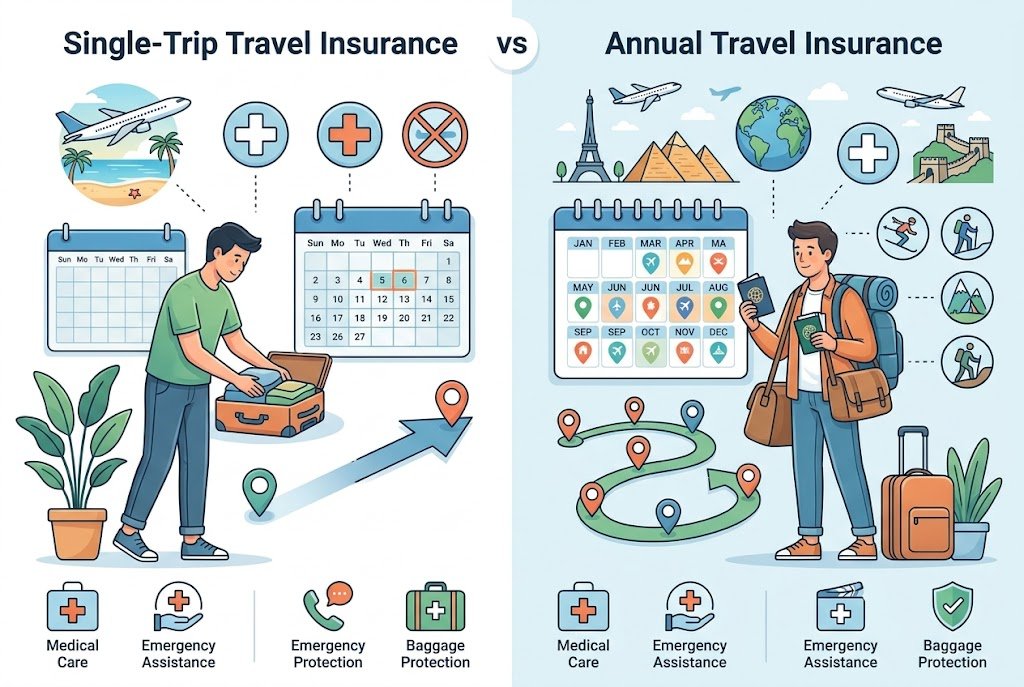
Single-Trip vs. Annual Travel Insurance
Frequent travelers may encounter two major options.
Single-trip insurance
This covers one specified journey.
It can make sense if:
- You take only one or two major trips
- You want coverage tailored to one itinerary
- Your trip is unusually expensive
- Your activities differ substantially between trips
Advantages
- Tailored to one trip
- Easier to match coverage with trip cost
- No need to pay for unused annual coverage
Disadvantages
- Requires buying another policy for each trip
- May become inconvenient for frequent travelers
Annual multi-trip insurance
Annual policies cover multiple trips during a policy year, subject to their conditions and maximum trip lengths. They can be attractive for people who travel frequently. But check the maximum duration of each individual trip. An annual policy does not necessarily mean you can travel continuously for an entire year.
Annual coverage may be useful when:
- You travel several times a year
- Your trips are relatively short
- You want simplified administration
- The annual premium compares favorably with repeated single-trip policies
Always compare actual coverage rather than assuming annual automatically means better value.
After exploring the benefits of travel insurance, you can also discover some of the best outdoor restaurants in the USA for memorable dining experiences during your trip — or, if Thailand is on your itinerary, explore outdoor restaurants in Thailand for an enjoyable open-air meal.
What Is Cancel For Any Reason Coverage?
Cancel For Any Reason (CFAR) is an optional type of broader cancellation protection offered by some policies. Unlike standard cancellation coverage, which generally requires a listed covered reason, CFAR can provide greater flexibility. However, it usually comes with important conditions.
Possible restrictions include:
- Higher premium
- Purchase deadlines
- Minimum percentage of trip costs insured
- Cancellation deadlines
- Partial rather than full reimbursement
NAIC notes that Cancel For Any Reason coverage can offer broader protection but typically reimburses less than the full trip cost. So CFAR is not simply “better travel insurance.” It is more flexible cancellation protection, which can be valuable for travelers who expect uncertainty.
How Much Does Travel Insurance Cost?

There is no reliable universal price.
Premiums can vary based on:
- Traveler age
- Destination
- Trip duration
- Trip cost
- Coverage limits
- Number of travelers
- Medical history
- Optional upgrades
- Type of activities
- Policy structure
- Cancellation benefits
Current comparison research shows substantial differences between plans and traveler profiles, which is why quoting your actual trip is more useful than relying on a generic percentage.
Avoid the “cheapest wins” approach
Suppose:
- Policy A costs $60
- Policy B costs $80
- Policy C costs $105
Policy A may appear attractive until you discover that it has lower medical coverage, a large excess, weaker interruption benefits, or excludes an activity you planned. The additional $20 or $45 could be worthwhile if it closes a major coverage gap.
Travel Insurance for International Trips
International travelers should pay particular attention to medical and evacuation benefits. Your domestic health plan may not provide comprehensive overseas protection. The CDC recommends that international travelers understand their existing health insurance and consider travel health and medical evacuation insurance when appropriate.
Before leaving, verify:
- Where the policy is valid.
- How emergency treatment is handled.
- Whether hospitals require upfront payment.
- How medical assistance is contacted.
- Whether evacuation is included.
- Whether repatriation is covered.
- Whether your planned activities are covered.
- Whether pre-existing conditions are covered.
- Whether the policy covers the full travel period.
- Whether transit countries are included.
Travel Insurance for Europe and Schengen Visas

Travelers applying for a Schengen visa should pay particular attention to the visa’s insurance requirements. Under the EU Visa Code, travel medical insurance for a uniform Schengen visa must meet specified conditions, including validity throughout the relevant Member States and a minimum coverage of €30,000 for covered medical expenses specified by the rules.
That means buying any generic policy is not enough. Your certificate should satisfy the current requirements for your visa application. Before submitting documents, verify the latest requirements with the relevant consulate or official EU guidance.
Planning a trip across Europe? Choosing the best travel insurance can help protect you against unexpected medical expenses, trip disruptions, and other travel-related issues.
Travel Insurance for Beach Holidays
Beach vacations can appear low-risk, but the activities surrounding them may not be.
Consider:
- Snorkeling
- Scuba diving
- Surfing
- Jet skiing
- Boat excursions
- Parasailing
- Motorbike rentals
- Hiking
- Remote island transfers
Weather can also affect travel plans. For example, a trip involving multiple ferries, island transfers, prepaid resorts, and water activities can have more potential disruption points than a simple city break.
Beach Near’s travel content similarly emphasizes considering transportation, activities, seasonal conditions, and insurance when planning beach trips. If you are still deciding where to travel, our guide to Best Countries to Visit can help you compare destinations before you purchase non-refundable arrangements.
Travel Insurance for Families

Family trips create additional considerations because several people are traveling under one itinerary.
Check:
- Whether all family members are covered
- Children’s age limits
- Medical coverage per person
- Cancellation coverage per traveler
- Family emergency provisions
- Trip interruption rules
- Baggage limits
- Whether one person’s illness can trigger cancellation benefits for the whole family
For a family vacation, cancellation protection can be especially valuable when a single unexpected event could affect the entire booking.
Travel Insurance for Seniors
Age can affect eligibility, price, medical underwriting, and policy conditions.
Older travelers should pay particular attention to:
- Pre-existing medical conditions
- Medical coverage limits
- Emergency evacuation
- Trip duration
- Age restrictions
- Medication-related requirements
- Cancellation coverage
Do not wait until after booking to investigate these terms. Some specialized policies may be more appropriate than general travel insurance.
Travel Insurance for Adventure Travel
Adventure travelers should treat activity exclusions as a primary selection criterion. Imagine buying a policy for a hiking trip and later discovering that the planned elevation, terrain, organized competition, or specific activity falls outside the policy definition. The policy’s general medical limit would not solve the problem.
Before purchasing, write down every significant activity:
- Diving
- Trekking
- Skiing
- Cycling
- Motorbike travel
- Surfing
- Rafting
- Climbing
- Wildlife excursions
Then confirm coverage.
When planning a coastal getaway, you can also explore oceanfront restaurants for memorable dining with scenic views. Travelers looking for unique dining experiences can discover underwater restaurants as part of their vacation plans. For travelers seeking a luxury dining experience, exploring the most expensive restaurants can add an unforgettable touch to a special trip.
What Travel Insurance Usually Does Not Cover
Policies differ, but travelers should expect exclusions and conditions. Common problem areas can include:
Changing your mind
Standard cancellation insurance is not usually a general refund guarantee.
Known problems
Buying insurance after a major travel disruption becomes known may not protect you against that event.
Undisclosed medical conditions
Failing to disclose relevant medical information can create serious claim problems.
Uncovered activities
An accident during an excluded activity may not qualify for benefits.
Unattended belongings
Leaving valuables unattended may violate baggage coverage conditions.
Alcohol-related incidents
Some policies restrict claims associated with intoxication.
Government travel warnings
Some policies contain exclusions related to traveling against official advice. The UK Foreign, Commonwealth & Development Office, for example, warns travelers that insurance can be affected when traveling against its advice. This does not mean every insurer uses identical wording. Check the policy that applies to you.
Common Travel Insurance Mistakes

Mistake 1: Choosing by price alone
Cheap insurance is not necessarily bad, but cheap coverage can become expensive when a major claim falls outside its limits.
Mistake 2: Ignoring medical evacuation
Travelers often focus on cancellation and baggage while overlooking the cost and logistics of emergency transportation.
Mistake 3: Assuming all medical conditions are covered
They are not necessarily covered automatically.
Mistake 4: Forgetting activities
Your beach holiday may include diving or motorbike travel that changes the insurance requirements.
Mistake 5: Buying too late
Insurance is intended to protect against unforeseen events, not problems that are already apparent. NAIC specifically advises travelers not to wait until the last minute when an event is already foreseeable
Mistake 6: Insuring refundable expenses
Do not pay for cancellation protection on costs you can already recover directly.
Mistake 7: Ignoring excesses
A low premium can be less attractive if the deductible or excess is high.
Mistake 8: Failing to keep documentation
Save:
- Policy certificate
- Policy wording
- Emergency phone number
- Booking confirmations
- Receipts
- Medical documentation
- Cancellation evidence
- Police reports where required
What to Do If You Need to Make a Claim
If something goes wrong, act quickly.
1. Protect yourself first
In a medical emergency, obtain appropriate medical assistance.
2. Contact the insurer
Use the emergency assistance number when required.
3. Follow instructions
Some policies require authorization before certain medical treatment or transportation.
4. Keep documentation
Save receipts, medical records, tickets, booking confirmations, reports, and correspondence.
5. Notify relevant providers
Depending on the event, contact:
- Airline
- Hotel
- Tour operator
- Cruise company
- Police
- Medical provider
6. Submit the claim accurately
Do not exaggerate the loss. Provide the documents requested by the insurer.
7. Keep copies
Maintain copies of everything submitted.
For serious emergencies, a 24-hour assistance service can be particularly useful. The U.S. Department of State advises travelers to check whether their insurance company offers a 24-hour help line.
A Practical Travel Insurance Buying Checklist
Before paying for a policy, answer these questions:
Trip
- Where am I going?
- How long will I be away?
- How many countries will I visit?
- Are any destinations remote?
Money
- How much have I prepaid?
- Which expenses are non-refundable?
- What cancellation limit do I need?
Medical
- Does my existing health insurance work abroad?
- Are my medical conditions properly disclosed?
- What is the emergency medical limit?
- Is emergency dental treatment included?
- Is medical evacuation included?
Activities
- Will I dive?
- Ski?
- Surf?
- Ride a motorbike?
- Hike?
- Participate in organized sports?
Exclusions
- What is excluded?
- What are the major limitations?
- What is the excess?
- Are there special conditions for my destination?
Claims
- Is there 24/7 assistance?
- How do I contact the insurer?
- What documentation will I need?
- Does the insurer require prior approval?
If you cannot answer these questions, you are probably not ready to compare policies purely by price.
Before choosing a travel insurance plan, use our International Travel Checklist to make sure you have essential documents, bookings, health preparations, and other important travel details covered.
Best Travel Insurance: A Simple Decision Framework
If you want a straightforward way to narrow your options, use this approach.
Choose comprehensive coverage if:
- Your trip is expensive
- You are traveling internationally
- You have significant non-refundable expenses
- Medical care at the destination could be costly
- You are traveling with family
- You are visiting multiple destinations
Consider medical-focused coverage if:
- You mainly want protection from healthcare costs
- Your trip expenses are mostly refundable
- You already have cancellation protection elsewhere
- You are taking a long or flexible trip
Consider annual coverage if:
- You travel several times each year
- Your trips fit the policy’s duration rules
- The annual premium is competitive with repeated single-trip policies
Consider specialist coverage if:
- You have complex medical circumstances
- You are older and face age-related restrictions
- You are taking part in adventure sports
- You are traveling for an unusually long period
- You are visiting remote locations
The best choice is the one that protects you from risks you cannot comfortably afford to absorb yourself.
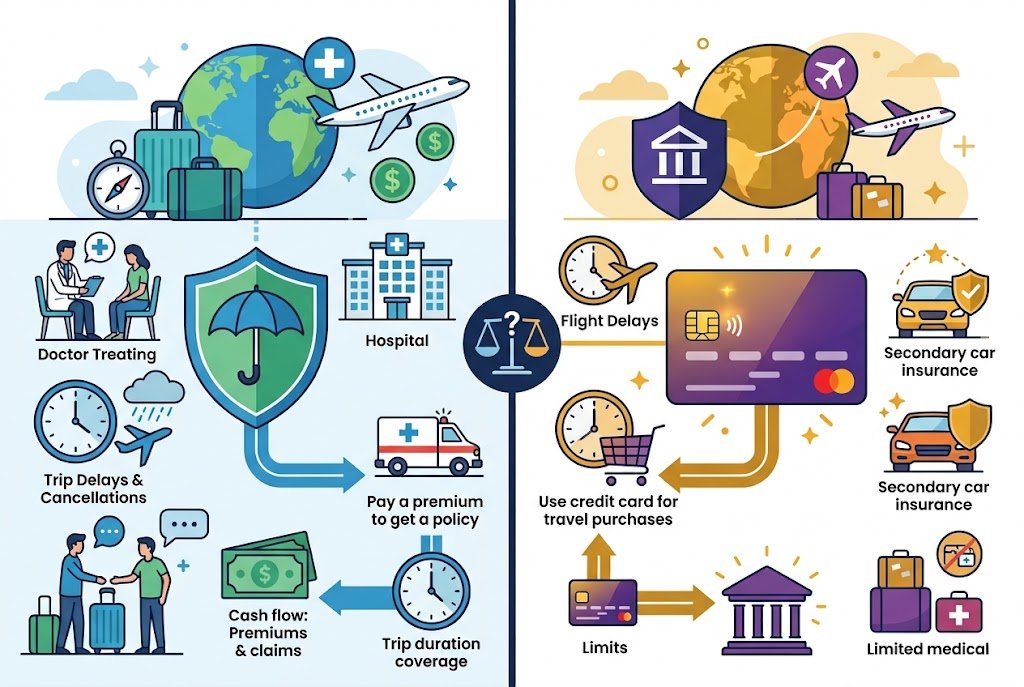
Travel Insurance vs. Credit Card Travel Protection
These are not necessarily mutually exclusive.
A credit card may provide benefits such as:
- Trip cancellation
- Trip interruption
- Travel delay
- Baggage protection
- Rental car protection
But coverage varies substantially.
Important questions include:
- Did you pay for the trip using the card?
- Who is covered?
- What are the limits?
- What events qualify?
- Does medical coverage exist?
- Is evacuation included?
- Are family members covered?
- Is there a deductible?
- What documentation is required?
If your card provides only limited cancellation protection but your international trip requires strong medical and evacuation coverage, standalone insurance may still be appropriate.
How to Compare Travel Insurance Providers in 2026
Current comparison publications illustrate why “best” depends on the category rather than a universal winner. For example, NerdWallet’s 2026 analysis evaluates insurers using factors including coverage breadth, cost, customization, and customer reviews, while Squaremouth’s current comparisons examine large numbers of policies and sales data. Different publications therefore produce different category winners.
That is an important lesson:
Do not treat a “best travel insurance” ranking as a universal recommendation.
A provider ranked highly for budget travel might not be the best choice for:
- A senior traveler
- A family cruise
- An adventure trip
- A long-term traveler
- Someone with a pre-existing condition
- A traveler needing unusually high cancellation coverage
Use rankings as a shortlist, then compare the actual policy available for your residence, destination, dates, and circumstances.
The Five Numbers Worth Checking First
When comparing policies, start with these:
- Emergency medical limit
- Medical evacuation limit
- Trip cancellation limit
- Trip interruption limit
- Baggage and baggage-delay limits
Then examine the less obvious items:
- Deductible/excess
- Activity exclusions
- Medical-condition rules
- Maximum trip length
- Assistance requirements
- Eligibility
- Claim deadlines
This method is usually more useful than comparing dozens of minor benefits.
Frequently Asked Questions
Q: Is travel insurance worth it?
Ans: For many international and expensive trips, it can be worthwhile because it can protect against risks that travelers may struggle to pay for themselves, particularly emergency medical treatment, evacuation, and large non-refundable expenses. Whether it is worthwhile depends on your trip, existing coverage, and financial risk tolerance.
Q: What is the most important travel insurance coverage?
Ans: For international travel, emergency medical and medical evacuation coverage are often among the most important benefits. For expensive prepaid trips, cancellation and interruption coverage can also be highly valuable.
Q: Does travel insurance cover flight cancellation?
Ans: It can, but usually only when the cancellation meets a covered reason in the policy. Standard travel insurance does not normally provide unrestricted refunds simply because you decide not to fly.
Q: Does travel insurance cover pre-existing medical conditions?
Ans: Sometimes, but not automatically. Policies can have specific eligibility requirements, exclusions, medical questionnaires, or waiver conditions. Disclose relevant medical information accurately and confirm coverage before purchasing.
Q: Is annual travel insurance better than single-trip insurance?
Ans: Not necessarily. Annual insurance can be convenient and cost-effective for frequent travelers, while single-trip coverage may be better suited to occasional travelers or unusually expensive journeys. Compare the actual benefits and maximum trip duration.
Q: Does travel insurance cover lost luggage?
Ans: Many policies offer baggage protection, but limits, exclusions, per-item caps, depreciation, reporting requirements, and documentation rules vary. Expensive electronics and valuables deserve particular attention.
Q: Does travel insurance cover adventure sports?
Ans: Some policies do, while others exclude or restrict specific activities. Check the exact activity definitions before traveling. Never assume that scuba diving, skiing, motorbike riding, climbing, or similar activities are automatically covered.
Q: Can I buy travel insurance after booking my trip?
Ans: In many cases, yes. However, purchasing earlier can be important for certain cancellation benefits, and some optional protections or pre-existing-condition provisions may have purchase-time requirements. Insurance generally cannot be used to insure an event that is already known.
Q: Does travel insurance cover COVID-19?
Ans: Coverage depends on the specific policy wording and circumstances. Do not assume that every policy treats COVID-19 identically. Check current medical, cancellation, interruption, and quarantine-related terms before buying.
Q: Do I need travel insurance for a domestic trip?
Ans: Not always. It depends on your existing health insurance, transportation and accommodation arrangements, cancellation exposure, and the risks associated with your trip. Domestic travel can still involve expensive non-refundable bookings or unexpected disruptions.
Q: What should I do before making a travel insurance claim?
Ans: Prioritize safety and medical care, contact the insurer as required, follow emergency-assistance instructions, notify relevant providers, and keep receipts and supporting documentation. Some claims can be affected if required notification or authorization procedures are not followed.
Final Thoughts
The best travel insurance is not necessarily the policy with the lowest premium, the highest headline limit, or the most impressive list of benefits. It is the policy whose actual terms match your trip. Start with your destination, trip cost, health circumstances, planned activities, and existing insurance. Then compare emergency medical coverage, evacuation, cancellation, interruption, baggage protection, exclusions, excesses, and claim procedures.
For international travel, give medical and evacuation protection serious attention. For expensive vacations, make sure cancellation and interruption limits reflect the money you could genuinely lose. If you have medical conditions or plan adventure activities, investigate those terms before purchasing rather than assuming standard coverage applies.
Finally, read the policy wording—not just the sales summary. A few minutes spent understanding exclusions and limits can be far more valuable than choosing a policy based solely on price. And before committing to non-refundable travel, make sure the destination itself, seasonal conditions, transportation, and activities fit your plans. That broader approach is what turns insurance from an afterthought into a useful part of responsible travel planning.