
 -by
-by Planning a cruise from the United States can look simple: choose a ship, book a cabin, pack your bags, and head to the port. For international travelers, however, the documentation can be more complicated. A cruise may involve the United States, several Caribbean destinations, Mexico, Canada, or other countries—and each country can have its own entry rules.
The important point is that there is no single universal “cruise visa” issued by the United States. The document you need depends on your nationality, your purpose for entering the U.S., your cruise itinerary, and whether you qualify for visa-free travel under the Visa Waiver Program (VWP).
For most foreign tourists entering the United States for a cruise vacation, the relevant U.S. immigration document is generally a B-2 visitor visa or a combined B-1/B-2 visa, unless the traveler qualifies for the Visa Waiver Program and obtains ESTA authorization. Some cruise itineraries can also raise transit-visa questions, while crew members follow different rules.
This guide explains how to determine the correct documentation, how the application process works, what cruise passengers should carry, common mistakes to avoid, and why checking every port—not just the departure port—is essential.
What Is a Cruise Visa?
A “cruise visa” is not a separate standard U.S. visa category for ordinary cruise tourists. Instead, cruise passengers normally use the U.S. visa or visa-waiver status appropriate to the reason they are entering the United States.
For a foreign tourist taking a U.S.-based cruise, that commonly means a B-2 visitor visa or B-1/B-2 visa, unless the traveler qualifies for the Visa Waiver Program and travels with approved ESTA authorization. The correct requirement can change according to nationality, itinerary, and immigration circumstances.
This distinction matters because the phrase “cruise visa” can make travelers think that buying a cruise package & ticket automatically creates a special immigration status. It does not. A cruise reservation and permission to enter a country are separate matters.
Do You Need a Visa for a Cruise From the USA?
The answer depends primarily on your passport nationality and itinerary. A foreign traveler who needs a U.S. visa for tourism generally needs the appropriate visitor visa before traveling to a U.S. cruise port. Travelers from Visa Waiver Program countries may instead be able to travel without a visa for eligible short visits if they satisfy all VWP requirements and receive ESTA approval. There are also special circumstances involving transit and maritime crew members.
A useful way to think about the question is:
- Where does your cruise begin?
- Where does it end?
- Which countries does the ship visit?
- What passport do you hold?
- Will you enter the United States as a tourist, transit passenger, crew member, or for another purpose?
- Does your nationality qualify for the Visa Waiver Program?
- Does each destination permit cruise passengers of your nationality to enter without a visa?
Answering these questions is much more reliable than searching for a generic “cruise visa.”
U.S. Cruise Visa Options for International Travelers

B-2 Visitor Visa
The B-2 visa is designed for temporary tourism and vacation travel. A foreign national traveling to the United States for a cruise vacation can generally fall within the tourism purpose of a visitor visa.
The U.S. Department of State lists tourism and vacation among activities permitted under the B-2 category. For many cruise passengers, a B-2 or combined B-1/B-2 visa is therefore the relevant U.S. visa category rather than a special cruise document.
B-1/B-2 Visa
Some travelers receive a combined B-1/B-2 visa. The B-1 component covers certain temporary business activities, while B-2 covers tourism and other qualifying visitor activities.
If your primary reason for the U.S. trip is a vacation cruise, the tourism component is the important one. Having a B-1/B-2 visa does not mean you can use it for any purpose. U.S. visa validity and permitted activities remain tied to the applicable immigration rules.
Visa Waiver Program and ESTA
Citizens or nationals of participating Visa Waiver Program countries may be eligible to travel to the United States without a traditional visitor visa for qualifying tourism or business trips of up to 90 days.
However, visa-free does not mean documentation-free. Eligible travelers generally need an approved Electronic System for Travel Authorization (ESTA) before traveling under the VWP and must meet all other requirements. This can apply to travel arriving by sea as well as by air.
C-1 Transit Visa
A transit visa is a different category. The U.S. Department of State explains that a C-1 transit visa can apply to certain foreign nationals traveling in immediate and continuous transit through the United States. It specifically gives an example involving a passenger embarking from a foreign port on a cruise ship proceeding to another country, where the ship makes a U.S. port call, and the passenger has no intention of landing in the United States.
That is a very different situation from a traveler flying or sailing into the United States for a vacation that includes a U.S.-based cruise. If sightseeing, visiting friends, or another non-transit purpose is part of the U.S. stay, a visitor visa rather than a pure transit visa may be appropriate. Because maritime itineraries can be complicated, travelers with unusual routes should confirm their exact situation with the appropriate U.S. embassy or consulate.
Cruise Visa vs. ESTA: What Is the Difference?
One of the most common sources of confusion is treating ESTA as a type of visa. It is not.
| Feature | U.S. Visitor Visa | ESTA / Visa Waiver Program |
| Who uses it? | Travelers who require a visa | Eligible nationals of VWP countries |
| Typical cruise purpose | Tourism | Tourism or qualifying business |
| Maximum VWP stay | Not applicable | Generally up to 90 days |
| Application | Visa application process | Electronic travel authorization |
| Interview | Generally required, subject to applicable exceptions | No consular visa interview |
| Passport requirements | Must satisfy visa and entry rules | Must satisfy VWP passport and eligibility rules |
| Guarantees admission? | No | No |
| Applies to cruise travel? | Potentially | Potentially, if VWP requirements are met |
An approved ESTA does not guarantee admission to the United States. Similarly, holding a U.S. visa does not guarantee admission. At the U.S. port of entry, U.S. Customs and Border Protection (CBP) determines whether the traveler may enter and under what conditions.
How to Determine Which U.S. Document You Need
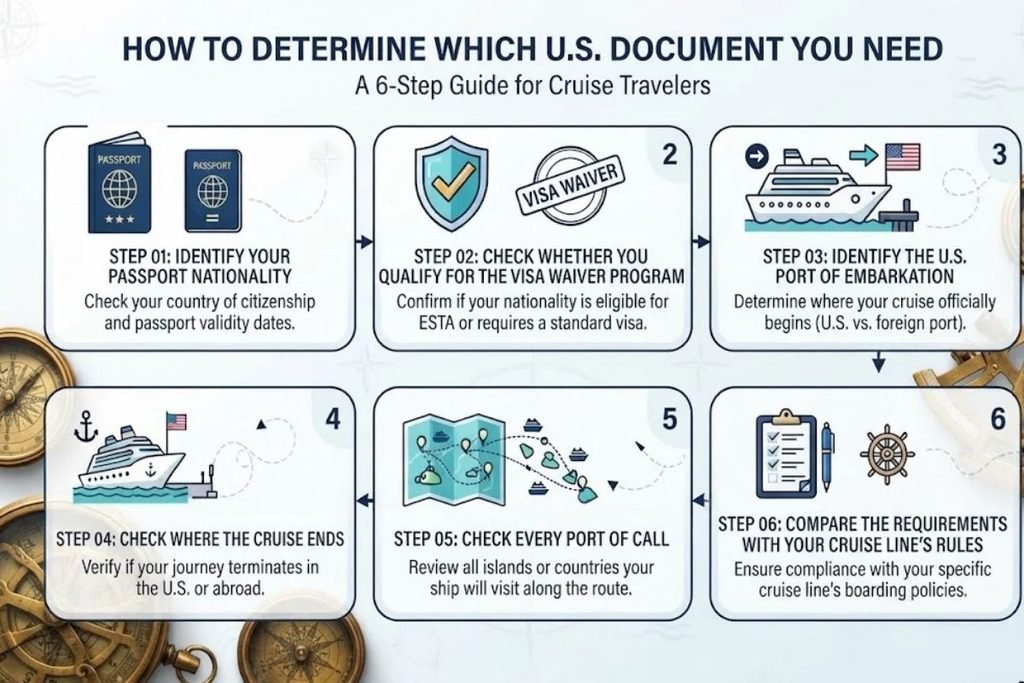
Use this practical decision process before paying for a cruise.
Step 01: Identify Your Passport Nationality
Start with the passport you will use for the journey. Visa requirements generally depend on nationality and immigration status, not where you currently live. For example, a person legally residing in a country different from their citizenship may still have U.S. visa requirements based on their nationality.
Step 02: Check Whether You Qualify for the Visa Waiver Program
If your nationality is covered by the VWP, check all eligibility conditions rather than assuming that nationality alone is enough. Certain travel history, dual nationality, or other circumstances can affect VWP eligibility. The U.S. Department of State maintains the authoritative VWP information, and travelers should check the current requirements before relying on ESTA.
Step 03: Identify the U.S. Port of Embarkation
Common U.S. cruise gateways include ports in Florida, California, Texas, Washington, New York, and other states. The location of the port does not create a special cruise visa category. Instead, it determines where you will seek admission to the United States if you are arriving from abroad.
Step 04: Check Where the Cruise Ends
A cruise that starts and ends in the United States is different from a cruise that begins in Miami Beach and ends in Europe, for example. An itinerary can create additional immigration requirements even when the traveler spends relatively little time ashore.
Step 05: Check Every Port of Call
Do not check only the United States. A cruise from Florida could visit several foreign countries. Each country may impose its own rules based on your passport, length of stay, transit status, and whether you leave the ship. The U.S. Department of State recommends that cruise passengers have the appropriate foreign visas for all stops when required—even if they do not plan to disembark.
Step 06: Compare the Requirements With Your Cruise Line’s Rules
Government immigration requirements and cruise-line boarding requirements are not necessarily identical. A cruise company can require documentation that is more conservative than the minimum immigration document a government would accept.
For that reason, check both:
- The relevant government or embassy.
- Your cruise line’s official documentation requirements.
How to Apply for a U.S. Cruise Visa
If you determine that you need a U.S. visitor visa, the application generally follows the normal visitor-visa process.
01. Complete Form DS-160
The first major step is completing the Online Nonimmigrant Visa Application, Form DS-160. Provide information accurately and consistently. Your travel plans should make sense with the purpose of your application. If your purpose is tourism and a cruise vacation, the information you provide should reflect that honestly.
02. Pay the Required Visa Application Fee
The U.S. Department of State currently lists a $185 nonimmigrant visa application fee for visitor visas, with possible additional visa issuance fees depending on nationality. Fees and rules can change, so confirm the current amount for your nationality and application location before payment. Some nationalities may also be subject to separate U.S. visa-bond requirements under current policies.
03. Schedule the Interview
Visa applicants generally schedule an appointment according to the procedures of the U.S. embassy or consulate handling their application. U.S. Department of State guidance currently directs nonimmigrant applicants toward applying in their country of nationality or residence, subject to applicable exceptions and designated processing arrangements. Interview availability can vary significantly by location. For that reason, applying shortly before a cruise can create unnecessary risk.
04. Prepare Supporting Documents
The exact document list can vary by embassy or consulate, but typical visitor-visa documentation can include:
- Valid passport
- DS-160 confirmation page
- Visa application fee receipt, where applicable
- Required photograph or confirmation of digital photo submission
- Information about the purpose of travel
- Evidence relevant to your ability to pay for the trip
- Evidence supporting your intention to leave the United States after the temporary visit
- Cruise itinerary and travel details when useful
- Employment, business, educational, or family information when relevant to demonstrating your circumstances
Do not create documents simply because you think an officer expects a particular paper. The U.S. Department of State emphasizes that applicants should qualify based on their own circumstances and ties abroad rather than relying on invitation letters from U.S. friends or relatives.
05. Attend the Interview if Required
A consular officer assesses whether you qualify under U.S. immigration law. Answer questions truthfully and directly.
For a cruise vacation, be prepared to explain practical details such as:
- Why you are traveling.
- Where your cruise starts.
- How long you plan to be in the United States.
- What countries your itinerary visits.
- Who is paying for the trip.
- What you do in your home country.
- What your plans are after the cruise.
There is no legitimate formula for “saying the right thing.” The strongest approach is accurate information that matches your actual circumstances and documents.
06. Wait for the Decision and Passport Return
Some applications are approved quickly, while others can require additional administrative processing. Do not assume that receiving an interview appointment means your visa will be issued by a particular date. The Department of State publishes current visa appointment information, but appointment estimates are not guarantees of processing time.
How Early Should You Apply for a Cruise Visa?
There is no universal number of days that guarantees a visa will be issued before a cruise. The safest approach is to begin the process well before your sailing date. Visa appointment availability changes by embassy and can fluctuate with demand, staffing, holidays, and other factors.
The Department of State publishes location-specific wait-time information and recommends planning. If your cruise is several months away, do not assume that you should wait until the final few weeks.
A visa application can involve:
- Completing the application.
- Paying the fee.
- Finding an appointment.
- Attending the interview.
- Possible administrative processing.
- Passport return.
- Cruise-line document verification.
Build your schedule around the possibility that one of these steps could take longer than expected.
Can You Book the Cruise Before Getting the Visa?
You can generally make a reservation, but there is a practical financial question: what happens if your visa is not issued before departure? The U.S. Department of State specifically advises visa applicants not to make final travel plans or buy tickets until they have a visa. Cruise reservations can also have their own cancellation and refund rules.
Before committing to a non-refundable cruise, check:
- Cruise cancellation terms.
- Travel insurance terms.
- Whether the cruise line offers any documentation-related flexibility.
- Visa appointment availability.
- Your embassy’s processing information.
A cruise ticket is not a substitute for immigration permission.
What Documents Should You Carry on a U.S.-Based Cruise?
For international cruise travelers, carrying the right documents is more than a formality.
A practical document folder can contain:
- Passport.
- U.S. visa, if required.
- ESTA approval information, if traveling under VWP.
- Cruise booking confirmation.
- Boarding documents.
- Complete itinerary.
- Visas or electronic authorizations for foreign ports, where required.
- Copies of important documents.
- Emergency contact information.
- Travel insurance information.
- Relevant residence or immigration documents, if applicable.
Keep originals secure and carry accessible copies or digital backups where appropriate.
Why a Passport Book Is Usually the Better Choice
Cruise passengers sometimes encounter passport exceptions that do not apply to every international situation. The U.S. Department of State strongly recommends that cruise passengers travel with a passport book because an unexpected event could require them to leave the cruise and fly home.
A passport card may be sufficient for certain U.S. sea reentries from specific destinations for eligible travelers, but it is not equivalent to a passport book for international air travel. For international travelers who already need a passport to enter the United States, the practical question is usually not whether they can avoid carrying one—it is whether the passport is valid and meets the requirements of every country on the itinerary.
Do You Need Visas for Foreign Cruise Ports?
Possibly. This is one of the most overlooked parts of cruise planning.
Suppose your itinerary looks like this:
Miami → Bahamas → Jamaica → Cayman Islands → Mexico → Miami
Your U.S. immigration requirement is only one part of the documentation problem. You must also determine whether your nationality needs permission to enter or transit each destination.
The rules can depend on:
- Passport nationality.
- Cruise itinerary.
- Whether the ship is making a port call.
- Whether you intend to leave the ship.
- Length of stay.
- Whether you are merely transiting.
- Current bilateral agreements.
- Local immigration rules.
Some countries permit cruise passengers to visit under special conditions, while others may require a visa even for a port visit. Never assume that “I am only staying for one day” automatically means “I don’t need a visa.”
Closed-Loop Cruises: What Does That Mean?

A closed-loop cruise generally refers to a cruise that begins and ends at the same U.S. port and visits destinations within the applicable region. This term matters particularly for U.S. citizens because U.S. reentry documentation rules can differ for certain closed-loop cruises.
It does not, however, mean that foreign nationals automatically avoid U.S. visa requirements. A foreign traveler must still determine whether they are authorized to enter the United States based on their nationality and immigration status. Likewise, foreign-port visa rules still apply. So, “closed-loop cruise” should never be treated as a universal visa exemption.
U.S. Citizens Taking Cruises: Do They Need a Visa?
U.S. citizens do not need a U.S. visa to enter the United States. The more important question for a U.S. citizen is whether the countries visited during the cruise require a passport or visa. For example, a cruise may travel through Canada, Mexico, the Caribbean, Europe, or other regions.
The U.S. Department of State recommends that cruise passengers carry a passport book, even when an itinerary might permit another document, because emergencies can force travelers to leave the ship and return by air. The documentation requirement should therefore be checked against the complete itinerary rather than just the cruise’s departure port.
U.S. Permanent Residents Taking a Cruise
Lawful permanent residents of the United States are in a different situation from foreign tourists applying for a U.S. visitor visa. A permanent resident generally does not apply for a B-2 visa simply to return to the United States.
However, permanent residents traveling internationally should carry the appropriate permanent resident documentation and passport and should verify the requirements of every foreign country on the itinerary based on their nationality. Cruise-line documentation rules can also differ by itinerary.
Cruise Crew Members Have Different Visa Rules
Do not confuse passenger visa rules with crew immigration rules. Foreign nationals entering the United States as crew members can require different visa classifications, including D visas and, in certain circumstances, combinations involving transit visas.
A passenger traveling for vacation should not use crew-visa information to determine their own documentation. If you are joining a cruise ship to work, contact the cruise company and the relevant U.S. embassy or consulate about the appropriate crew documentation.
What If Your Cruise Only Stops in the United States?
This is where the distinction between transit and tourism becomes especially important. Consider two hypothetical travelers.
Example 01: U.S. Based Vacation Cruise
A traveler flies to Miami, stays briefly, boards a cruise, visits Caribbean destinations, and returns to Miami. The traveler is coming to the United States for tourism and a vacation. If a visa is required, a visitor visa is generally the relevant category.
Example 02: Foreign Cruise With a U.S. Port Call
A traveler boards a ship in Europe. The ship visits a U.S. port during a journey that continues to another country, and the traveler has no intention of entering the United States for tourism. A transit category may potentially become relevant. The U.S. Department of State specifically identifies this type of cruise situation in its C-1 transit guidance.
Because small differences in itinerary can change the applicable immigration category, travelers with unusual cruise routes should verify their individual circumstances rather than selecting a visa based solely on the word “cruise.”
Common Cruise Visa Mistakes

Mistake 01: Assuming There Is a Special U.S. Cruise Visa
There is no general tourist visa category called “cruise visa.” Determine the correct U.S. immigration category based on the actual purpose of your trip.
Mistake 02: Checking Only the Cruise Line’s Website
Cruise lines provide useful documentation information, but immigration rules come from governments. Check both the cruise company and the relevant government sources.
Mistake 03: Checking Only the U.S. Requirement
A U.S. visa does not automatically give you permission to visit Jamaica, Mexico, Canada, the Bahamas, or another country. Every country can have separate entry rules.
Mistake 04: Waiting Until the Month of Departure
Visa appointments and processing times vary. A last-minute application can create a serious scheduling problem.
Mistake 05: Assuming ESTA Is a Visa
ESTA is an authorization associated with travel under the Visa Waiver Program. It does not turn a traveler into a traditional visa holder.
Mistake 06: Assuming a Visa Guarantees Entry
A visa allows you to travel to a U.S. port of entry and request admission. CBP makes the admission decision.
Mistake 07: Buying a Non-Refundable Cruise Before Checking Documentation
If your nationality requires a visa, verify the visa pathway before making expensive, irreversible arrangements.
Mistake 08: Relying on an Old Visa Rule
Immigration requirements can change. Always verify the current rules shortly before travel.
Cruise Visa Planning Checklist
Use this checklist before finalizing your cruise arrangements.
Before Booking
- Identify your passport nationality.
- Check whether you need a U.S. visa or may qualify for VWP/ESTA.
- Review the full cruise itinerary.
- Check foreign-port entry requirements.
- Check passport validity.
- Review the cruise line’s documentation rules.
- Review cancellation terms.
Before Applying for a U.S. Visa
- Complete the DS-160 accurately.
- Check the current fee.
- Identify the correct embassy or consulate process.
- Check appointment availability.
- Prepare relevant supporting documents.
- Keep your cruise itinerary available.
Before Departure
- Confirm your U.S. visa or ESTA status.
- Confirm passport validity.
- Confirm every foreign-port requirement.
- Verify whether visas must be multiple-entry.
- Keep documents accessible.
- Carry a passport book when practical.
- Keep emergency and insurance information available.
At the Port
- Have the documents required by the cruise line ready.
- Do not assume that a digital photograph of your passport will replace the original.
- Follow the cruise company’s check-in instructions.
- Allow additional time for document verification.
What Happens If You Do Not Have the Required Visa?
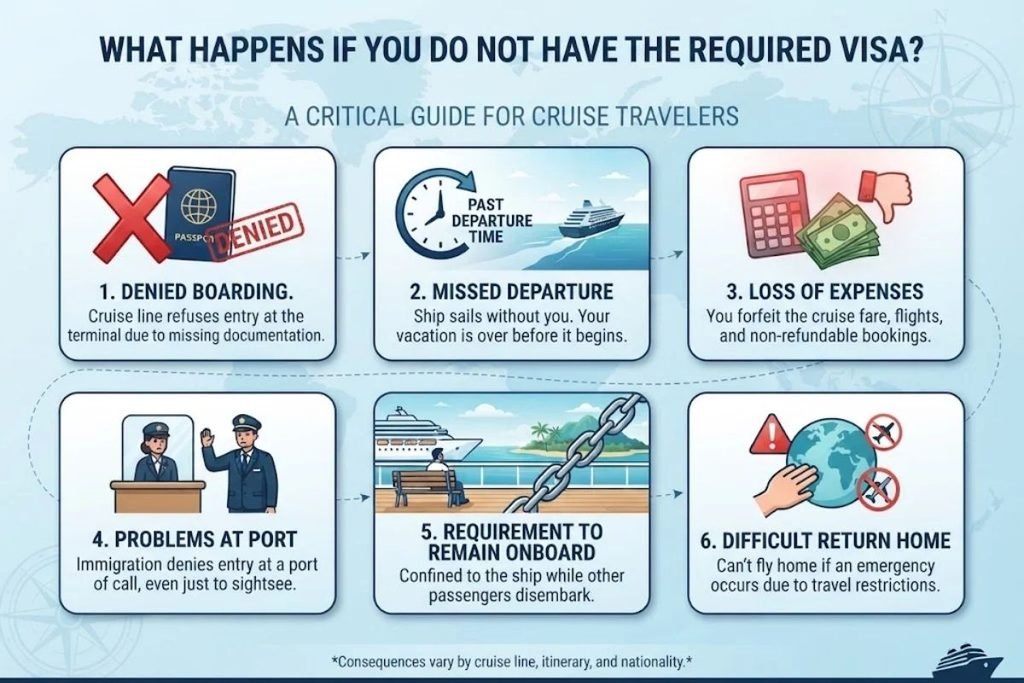
The consequences can be significant. A cruise line may refuse boarding when required documentation is missing. Even if the ship itself can legally visit a destination, the passenger may still fail to meet the immigration requirements for that person’s nationality.
Possible consequences include:
- Denied boarding.
- Missed departure.
- Loss of cruise-related expenses depending on the booking terms.
- Problems entering a port.
- Requirement to remain onboard.
- Difficulty returning home if an emergency occurs.
The exact consequences depend on the circumstances and the rules of the cruise line and countries involved. This is why documentation should be treated as part of the cruise booking process—not as something to check the day before sailing.
Travel Insurance and Cruise Documentation
Travel insurance does not replace a visa, passport, ESTA, or other immigration document. However, it can be useful for unrelated travel risks, including certain medical emergencies, trip interruptions, or evacuation expenses depending on the policy. The U.S. Department of State recommends that cruise passengers consider medical and emergency evacuation insurance.
When comparing policies, pay attention to:
- Medical coverage.
- Emergency evacuation.
- Trip interruption.
- Trip cancellation.
- Missed connections.
- Cruise-specific exclusions.
- Pre-existing-condition provisions.
- Coverage limits.
- Destination restrictions.
For broader travel-planning information, readers may also find the best travel & backpack guide useful when comparing coverage features before an international trip.
A Practical Example: First-Time International Cruise Passenger
Imagine a traveler from a country that is not part of the Visa Waiver Program. The traveler wants to take a seven-day Caribbean cruise departing from Florida.
A sensible planning sequence would be:
- First, check the passport’s validity.
- Second, determine whether a U.S. visitor visa is required.
- Third, if required, apply using the appropriate U.S. visitor visa process.
- Fourth, examine every Caribbean destination on the itinerary and determine whether the traveler’s nationality requires a visa or special authorization.
- Fifth, review the cruise company’s document requirements.
- Sixth, check appointment and processing timelines before committing to non-refundable travel.
- Finally, carry the passport, U.S. visa, cruise documents, and any foreign-port documentation throughout the trip.
This process may feel slower than simply buying a cruise and checking in online, but it addresses the actual immigration risks.
A Second Example: VWP Traveler
Now consider a traveler whose nationality is eligible for the Visa Waiver Program. The traveler plans to fly to Miami and board a Caribbean cruise. Instead of automatically applying for a B-2 visa, the traveler should first determine whether all VWP conditions are satisfied. If eligible, the traveler generally needs approved ESTA authorization before traveling under VWP.
But the traveler still needs to:
- Meet VWP requirements.
- Use a qualifying passport.
- Check every cruise destination.
- Follow the cruise line’s documentation requirements.
- Understand that ESTA does not guarantee admission.
Visa-free travel is therefore better understood as a different immigration pathway, not as the absence of immigration rules.
How Cruise Travelers Can Reduce Documentation Problems
The best strategy is to create a document matrix before sailing.
Make a simple table like this:
| Travel point | Requirement to check |
| U.S. departure port | U.S. visa or VWP/ESTA |
| U.S. reentry | Passport and applicable U.S. admission rules |
| Port 1 | Destination visa/entry rules |
| Port 2 | Destination visa/entry rules |
| Port 3 | Destination visa/entry rules |
| Final destination | Entry and onward-travel requirements |
| Cruise line | Boarding documentation |
| Emergency return | Passport and ability to travel by air |
This approach prevents a common planning error: verifying the first and last destinations while forgetting an intermediate port.
How Often Should You Recheck Visa Rules?
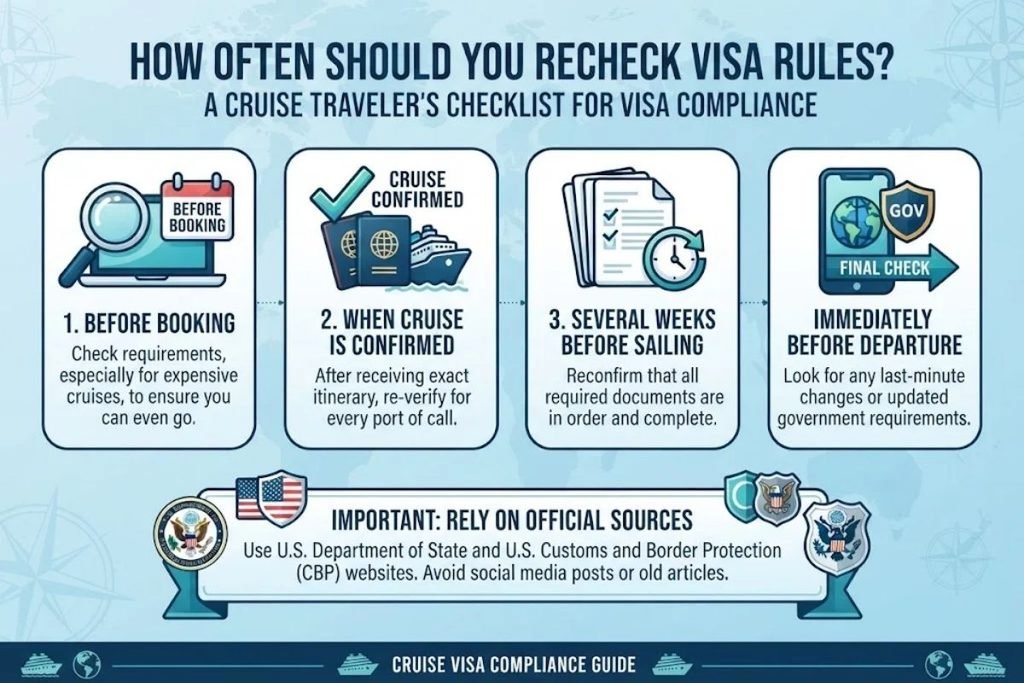
Check at several stages:
- Before booking, especially for expensive cruises.
- When your cruise is confirmed, after you know the exact itinerary.
- Several weeks before sailing, when documentation should already be complete.
- Immediately before departure, for any changes or updated government requirements.
This is particularly important because visa policies, appointment procedures, entry requirements, and cruise-line documentation policies can change. For official U.S. requirements, rely primarily on the U.S. Department of State and U.S. Customs and Border Protection rather than social-media posts or old travel articles.
Final Thoughts
A cruise may feel like one vacation, but immigration authorities see it as a sequence of international movements. That is why the phrase “Cruise Visa” can be misleading: there is usually no single document that covers the entire journey. For a U.S.-based cruise, begin with your passport nationality and U.S. entry requirements.
Determine whether you need a B-2 or B-1/B-2 visitor visa, or whether you qualify for the Visa Waiver Program and ESTA. Then move beyond the United States and check every foreign port on the itinerary. The most important practical rule is simple: do not assume that a cruise ticket, ESTA, U.S. visa, or residence permit automatically covers every country on the route.
Check official government requirements, confirm the cruise line’s documentation rules, allow sufficient time for visa processing, and keep your passport and travel documents accessible. A few careful checks before departure can prevent a documentation problem from becoming a missed cruise. For the latest U.S. requirements, always verify information with official government sources because visa procedures and entry policies can change.
Frequently Asked Questions
Q01. Is there a special cruise visa for the USA?
Ans: No. The United States does not have a general tourist visa category specifically called a “cruise visa.” The appropriate immigration document depends on the traveler’s purpose, nationality, and itinerary. For tourism, this may be a B-2 or B-1/B-2 visitor visa, unless the traveler qualifies for the Visa Waiver Program.
Q02. Do I need a U.S. visa to take a cruise from Miami?
Ans: If you are a foreign national who requires a U.S. visa to enter the country for tourism, generally yes. If you qualify for the Visa Waiver Program, you may instead be able to travel with approved ESTA authorization and meet the other VWP requirements.
Q03. Can I use ESTA for a cruise?
Ans: Potentially, yes. Eligible VWP travelers can use the Visa Waiver Program for qualifying tourism travel, including travel by sea. However, they must satisfy all VWP requirements and obtain ESTA authorization before traveling under the program.
Q04. Does a U.S. visa guarantee that I can board my cruise?
Ans: No. A visa does not guarantee U.S. admission, and the cruise line may have its own document requirements. You should satisfy both government immigration requirements and the cruise company’s boarding requirements.
Q05. Do I need a visa for every country on my cruise?
Ans: Not necessarily. It depends on your nationality and each country’s entry rules. Some destinations may allow cruise passengers to visit without a visa, while others may require one. Check every port on the itinerary.
Q06. Can I get a U.S. cruise visa at the cruise port?
Ans: Do not plan on obtaining a normal tourist visa at the U.S. cruise terminal. If you require a U.S. visitor visa, you should obtain it through the appropriate U.S. visa process before travel.
Q07. How long does a U.S. cruise visa take?
Ans: There is no single processing time. Appointment availability and processing can vary by embassy or consulate. Some applications may also require additional administrative processing. Check the current U.S. Department of State wait-time information for the location where you will apply.
Q08. Can I take a cruise if my U.S. visa is still pending?
Ans: You should not assume that you can. If the Cruise Visa requires you to enter the United States and you require a visa, you need to consider whether the visa will be issued before the relevant travel date. Check your cruise’s cancellation terms and avoid assuming approval.
Q09. Do U.S. permanent residents need a U.S. tourist visa for a cruise?
Ans: Generally, lawful permanent residents do not need a B-2 visa simply to return to the United States. They should travel with the required permanent resident documentation and passport and check the visa requirements of all foreign destinations based on their nationality.
Q10. Do cruise crew members use the same visa as passengers?
Ans: No. Crew members can fall under different U.S. visa categories, including D and certain combined transit/crew classifications. Passenger tourism rules should not be used to determine crew immigration requirements.
Q11. Should I carry a passport book on a cruise?
Ans: For international cruise travel, carrying a passport book is strongly recommended. The U.S. Department of State notes that an emergency could require a traveler to leave the ship and return by air, which can make a passport book particularly important.
Q12. What is the safest way to check cruise visa requirements?
Ans: Start with official U.S. government information for U.S. entry requirements, then check the official immigration or foreign ministry information for every country on the itinerary. Finally, compare those requirements with your cruise line’s documentation rules.